Table of Contents
5.4 Life on other planets
1. Habitable zones
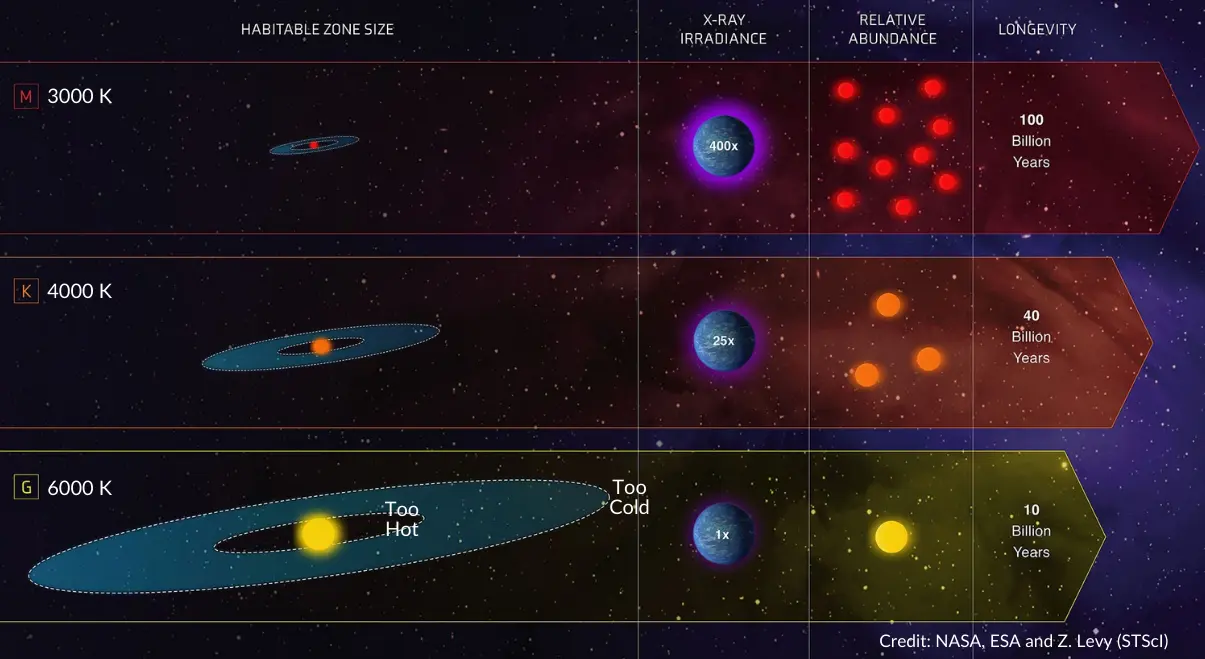
The circumstellar habitable zone represents the orbital region where liquid water can persist on a planetary surface, a distance determined primarily by a star’s temperature and luminosity. As illustrated, G-type stars at 6000 K possess a wide habitable zone situated far from the star with a baseline X-ray irradiance of 1x. Conversely, cooler K-type stars at 4000 K have a more compressed zone, while M-type stars at 3000 K feature an extremely narrow habitable zone positioned very close to the stellar surface. This proximity subjects M-type planets to 400 times the X-ray radiation of Earth, potentially compromising atmospheric stability despite the presence of liquid water.
Beyond radiation and distance, stellar longevity and abundance are critical factors in evaluating planetary habitability over cosmic timescales. While G-type stars provide stable radiation, they are the least abundant and have the shortest lifespans, lasting only 10 billion years. K-type stars offer an attractive middle ground, with a longevity of 40 billion years and moderate relative abundance. M-type stars are the most numerous in the galaxy and possess the greatest longevity, remaining stable for 100 billion years. Consequently, while G-type stars are hospitable, the vast numbers and extreme lifespans of cooler stars provide significantly more opportunities for long-term evolutionary processes to occur.

The search for Earth-like habitable planets relies on mapping a star’s circumstellar habitable zone, defined as the orbital region where liquid water can remain stable on a planetary surface. As illustrated in the diagram, researchers distinguish between a Conservative Habitable Zone and a broader Optimistic Habitable Zone, which accounts for atmospheric variations that might extend planetary viability. Earth serves as the primary benchmark for this scale, positioned at 100% of the Sun’s temperature and receiving exactly 100% of our solar radiation. For cooler stars, such as M-type dwarfs at 50% of the Sun’s temperature, the habitable zone shifts toward lower starlight intensities, requiring planets to orbit much closer to their host stars to maintain temperate conditions.
By early 2026, astronomers have confirmed over 6,000 exoplanets, including a refined catalog of 45 rocky worlds residing within these habitable boundaries. This group includes prominent candidates such as Proxima Centauri b and the TRAPPIST-1 system, which are concentrated around smaller, cooler stars. Recent discoveries like TOI-715 b and the “cold Earth” candidate HD 137010 b demonstrate the success of missions like TESS and the James Webb Space Telescope in identifying terrestrial analogs. Although planets orbiting Sun-like stars remain harder to detect, the abundance of rocky worlds around M-dwarfs suggests that life-sustaining environments are common throughout the galaxy, providing prime targets for atmospheric biosignature research.
2. Searching for life
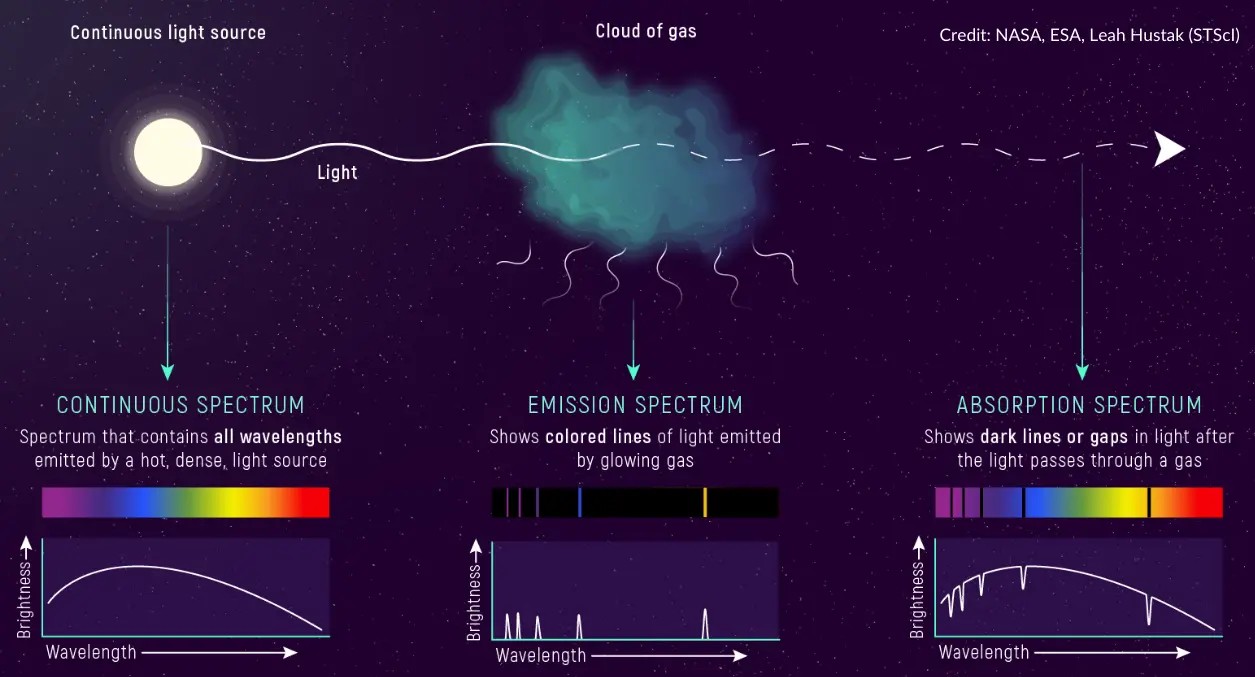
Spectroscopy serves as a fundamental tool in astronomy by analyzing the interaction between light and matter to determine the physical properties and chemical composition of celestial objects. As illustrated in the diagram, a hot and dense light source produces a continuous spectrum, which contains a seamless range of all visible wavelengths. When a cloud of gas is energized, it generates an emission spectrum characterized by distinct bright, colored lines at specific wavelengths that correspond to the unique energy transitions of the atoms within that gas. Alternatively, when light from a continuous source passes through a cooler cloud of gas, an absorption spectrum is created, revealing dark lines or gaps where the gas has filtered out specific wavelengths. By analyzing these spectral “fingerprints,” astronomers can identify the elemental makeup, temperature, and density of distant stars and nebulae without ever needing to visit them.
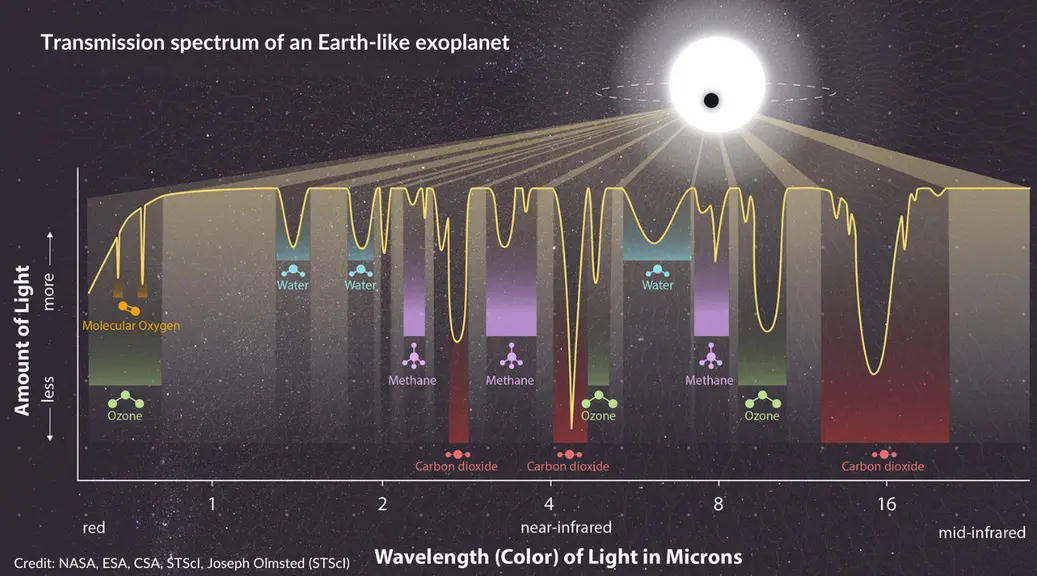
A transmission spectrum is a specialized astronomical tool used to determine the chemical composition of an exoplanet’s atmosphere by analyzing starlight as it passes through the planet’s gaseous envelope during a transit. As illustrated in the diagram, when an exoplanet moves in front of its host star, different gas molecules in its atmosphere absorb specific wavelengths of light, spanning from the visible red end of the spectrum into the mid-infrared range of sixteen microns. These absorption events manifest as distinct dips in the graph, representing the “lesser” amount of light that reaches the observer at those specific frequencies. By identifying these unique spectroscopic fingerprints for molecules such as water vapor, methane, and carbon dioxide, researchers can effectively map the invisible gases surrounding a distant world and determine its atmospheric density.
Beyond identifying simple atmospheric components, transmission spectroscopy is the primary method for detecting biosignatures, which are chemical indicators of potential biological activity on an exoplanet. The presence of specific gases, such as molecular oxygen and ozone depicted in the figure, is particularly significant because these molecules are often linked to photosynthesis or other life-sustaining processes on Earth. Finding a combination of water, methane, and carbon dioxide in chemical disequilibrium provides compelling evidence for a habitable or even inhabited environment. By analyzing these complex spectral profiles, astronomers can distinguish between barren, geologically dead worlds and planets with active biospheres, marking a transformative step in our quest to find life elsewhere in the galaxy.