Table of Contents
6.2 Rise of the eukaryotes
1. History
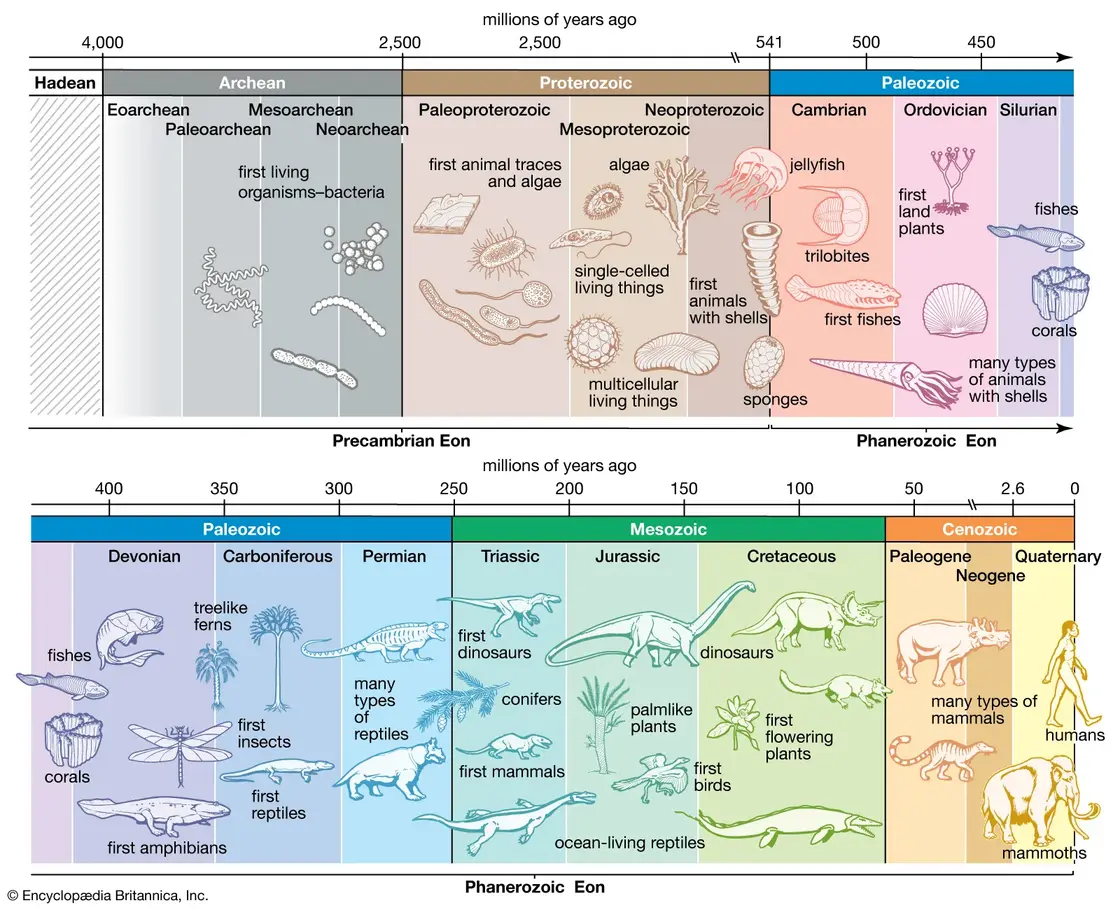
The evolution of eukaryotic life, as depicted in the provided geological timeline, began approximately 2,500 million years ago during the Proterozoic Eon. Moving beyond the simple, single-celled bacteria of the Archean, this era saw the rise of the first single-celled living things with complex internal structures. These early eukaryotes eventually transitioned into multicellular forms, including algae and the first animal traces. By the Neoproterozoic, life had diversified into soft-bodied organisms like jellyfish and sponges. This foundational period established the biological complexity necessary for the rapid diversification of life forms that would soon follow in the Phanerozoic Eon, transitioning from microscopic entities to visible, multicellular organisms.
As the timeline progresses into the Paleozoic Era, specifically between 541 and 500 million years ago, the fossil record illustrates a dramatic surge in eukaryotic complexity known as the Cambrian Explosion. This period introduced the first animals with hard shells, such as trilobites, and the earliest ancestral fishes. The diagram shows that by the Ordovician and Silurian periods, eukaryotes had begun to colonize the terrestrial environment, with the emergence of the first land plants and corals. This shift from strictly marine habitats to land-based ecosystems required significant evolutionary adaptations, setting the stage for the massive expansion of diverse plant and animal lineages that would eventually dominate the Earth’s continents.
During the later Paleozoic, spanning 400 to 250 million years ago, the evolution of eukaryotes favored specialized terrestrial adaptations. The Devonian and Carboniferous periods saw the rise of treelike ferns and the first insects, followed closely by the emergence of the first amphibians. These organisms represented a bridge between aquatic and terrestrial life, leading to the development of the first reptiles. By the Permian period, many types of reptiles had evolved, showcasing the success of the eukaryotic body plan in adapting to various ecological niches. This era concluded with a planet covered in lush forests and inhabited by increasingly complex vertebrate and invertebrate life forms across all major environments.
The Mesozoic Era, starting 250 million years ago, marks a period of significant evolutionary refinement among eukaryotes, famously characterized by the dominance of dinosaurs. This “Middle Life” era saw the first appearance of mammals and birds, alongside the diversification of conifers and palm-like plants. As the Jurassic and Cretaceous periods progressed, the first flowering plants emerged, representing a major milestone in botanical evolution. Meanwhile, in the oceans, giant reptiles returned to the sea, demonstrating the flexibility of the eukaryotic lineage. These millions of years were defined by a high-stakes biological arms race that produced some of the most specialized and massive terrestrial organisms to ever exist.
The final 66 million years of the timeline, the Cenozoic Era, document the modern configuration of eukaryotic life following the extinction of the dinosaurs. This era is defined by the rapid radiation of many types of mammals, including the appearance of mammoths and early primates. The diagram culminates in the Quaternary period with the emergence of humans, the most recent addition to the eukaryotic tree. This progression from the simple Proterozoic cells to the complex social and biological structures of modern mammals illustrates a continuous thread of evolutionary innovation. The history of eukaryotes is thus a journey from microscopic simplicity to the vast biological diversity that characterizes our contemporary world.
2. Eukaryotic cells and DNA
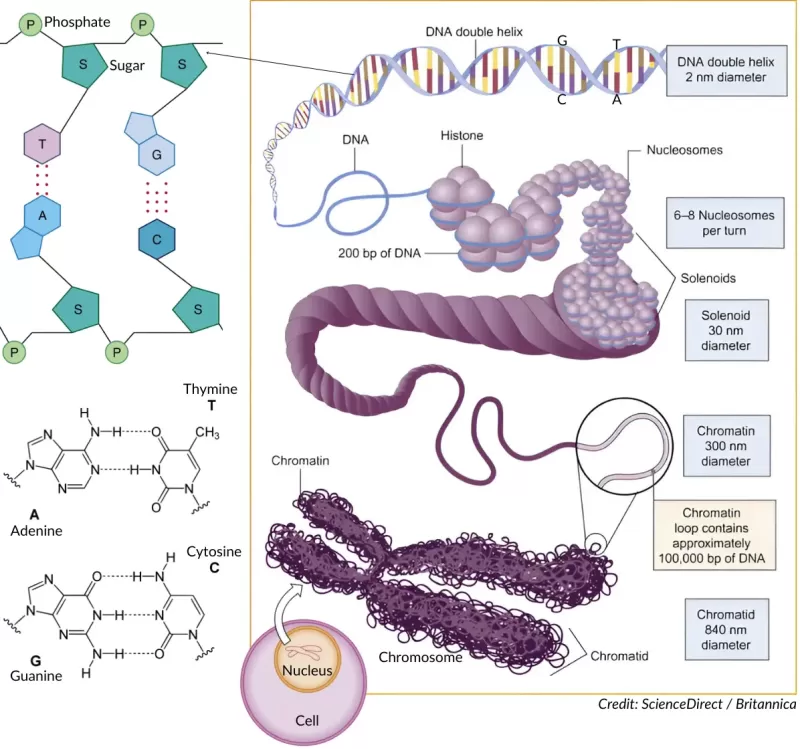
At the most macroscopic level of this biological hierarchy, the diagram depicts a eukaryotic cell containing a distinct nucleus where the genetic blueprint is sequestered. Inside this membrane-bound organelle, the vast library of hereditary information is organized into massive structures known as chromosomes. Each chromosome consists of two identical strands called chromatids, which are joined at a central point and represent the most condensed form of genetic material visible during cell division. These dense, X-shaped bodies serve as the primary transport vehicles for genome distribution. By focusing closer on the chromatid, which measures approximately eight hundred and forty nanometers in diameter, one begins to see the complex layering of the underlying fibers.
Transitioning into the microscopic landscape, the chromatid unravels into expansive chromatin loops, each spanning roughly one hundred thousand base pairs. This loosely packed chromatin further resolves into an intricate three hundred nanometer fiber that maintains the integrity of the genomic sequence. Upon closer magnification, the structure reveals even tighter coils called solenoids, which possess a thirty nanometer diameter. These solenoids are formed by the helical winding of many individual nucleosomes, which resemble beads on a string. Every nucleosome represents the fundamental repeating unit of chromatin, acting as a critical organizational hub that facilitates the extreme compaction required to fit several meters of DNA inside a microscopic cellular environment through metabolic stability.
Penetrating further into the core of the nucleosome, the DNA is seen wrapping around an octameric protein core called a histone. This interaction involves approximately two hundred base pairs of the DNA double helix per unit. Zooming into the helical strands reveals a two nanometer wide spiral composed of a repeating phosphate-sugar backbone. On the interior, specific chemical entities known as nucleobases form complementary pairs that hold the strands together. These bases consist of adenine, thymine, cytosine, and guanine, which are identified by their specific hydrogen bonding patterns. Guanine and cytosine share three bonds, while adenine and thymine share two, ensuring the precise encoding of all life’s complex and biological diversity.