6.4 Life in the universe
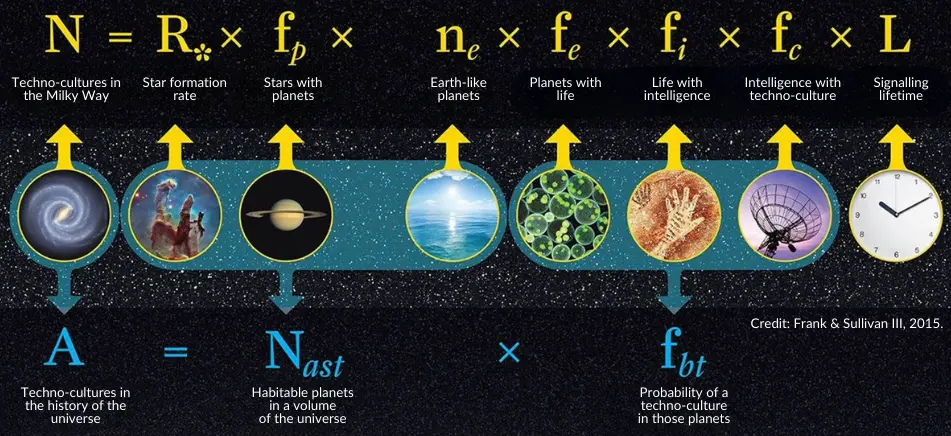
The quest to quantify the probability of extraterrestrial intelligence is elegantly encapsulated in the Drake Equation, formulated by astrophysicist Frank Drake in 1961. As illustrated in the upper portion of the provided diagram, this probabilistic formula estimates the number of active, communicative extraterrestrial civilizations in the Milky Way galaxy, denoted by the parameter $N$. The framework acts not as a strict mathematical proof, but rather as a heuristic tool to stimulate scientific dialogue by breaking down a monumental astrobiological question into smaller, quantifiable variables. The visual representation highlights the progressive filtering of cosmic conditions necessary for such civilizations to emerge, starting from the macroscopic scale of galactic star formation and systematically narrowing down to the emergence of communicative technologies.
The first phase of the Drake Equation relies on astronomical parameters that modern science has successfully quantified with high precision. The initial parameter, $R_*$, represents the rate of star formation within our galaxy. Utilizing data from missions like Gaia, modern astrophysical consensus estimates this rate to be approximately 1.5 to 3 solar masses per year. Following this is $f_p$, the fraction of those stars that host planetary systems. Thanks to the monumental discoveries of the Kepler Space Telescope, we now understand that exoplanets are ubiquitous; current estimates suggest $f_p$ approaches 1, meaning nearly every star possesses at least one planet. The next factor, $n_e$, quantifies the average number of Earth-like planets residing within the habitable zone of their parent star, where liquid water could theoretically exist. Recent exoplanetary surveys place $n_e$ between 0.16 and 0.20 for Sun-like and red dwarf stars, indicating that habitable real estate is relatively common throughout the cosmos.
The equation then transitions into the biological and sociological realms, where empirical data is currently non-existent. The variable $f_l$ represents the fraction of habitable planets where life actually emerges. This remains deeply uncertain; some biochemists argue that abiogenesis is a thermodynamic imperative, yielding an $f_l$ near 1, while others suggest it is a staggeringly rare event. Next is $f_i$, the fraction of life-bearing planets that evolve intelligent life, a highly debated concept within evolutionary biology regarding whether intelligence is a convergent trait or a fortunate accident. Following intelligence is $f_c$, the fraction of intelligent civilizations that develop a techno-culture. In modern astrobiology, a techno-culture is defined as a civilization capable of manipulating its environment to the extent that it produces detectable technological signatures, such as radio communications, megastructures, or atmospheric industrial pollutants. Finally, $L$ represents the signalling lifetime, or the duration such a techno-culture remains active and detectable. Estimates for $L$ range from a pessimistic century—reflecting the potential for self-destruction via nuclear conflict or ecological collapse—to millions of years for stable, mature societies.
Given the profound uncertainties in the latter parameters, estimating a definitive value for $N$ is highly speculative. Optimistic calculations, assuming life and intelligence are common and civilizations endure long lifetimes, suggest $N$ could be in the tens of thousands or millions. Conversely, pessimistic estimates drive $N$ down to 1 or lower, implying humanity is currently isolated in the Milky Way. This stark dichotomy directly introduces the Fermi Paradox, which highlights the glaring contradiction between the high mathematical probability of extraterrestrial life under optimistic Drake estimates and the absolute lack of empirical evidence for their existence. If techno-cultures are abundant, their electromagnetic signals, interstellar probes, or self-replicating machinery should theoretically be detectable across the galaxy. The profound silence of the universe suggests either that our estimates for the emergence of life and intelligence are vastly overstated, or that the lifetime $L$ of such civilizations is inherently brief due to insurmountable existential filters.
To bypass the uncertainties of the Drake Equation, particularly the elusive variable $L$, Adam Frank and Woodruff Sullivan proposed a revised framework in 2015, shown in the lower portion of the diagram as the Astrobiological Copernican Equation. Instead of asking how many civilizations currently exist, they calculate $A$, the total number of techno-cultures that have ever existed throughout the history of the observable universe. The parameter $N_{ast}$ represents the total number of habitable planets in a given volume of the universe. For the observable universe, $N_{ast}$ is staggeringly large, conservatively estimated at roughly $4 \times 10^{21}$. The parameter $f_{bt}$ represents the probability that a techno-culture develops on any given habitable planet, effectively combining the biological and sociological hurdles of the Drake Equation. Frank and Sullivan demonstrated that for humanity to be the sole techno-culture in the entire history of the cosmos, the probability $f_{bt}$ must be less than one in ten billion trillion ($10^{-22}$). Therefore, unless the emergence of a techno-culture is an incredibly miraculous event, the probable value of $A$ is vastly greater than one, strongly implying that advanced civilizations have existed prior to our own, even if we are separated by the vast gulfs of space and time.