
Table of Contents
This is an old revision of the document!
4.2 Types of planets
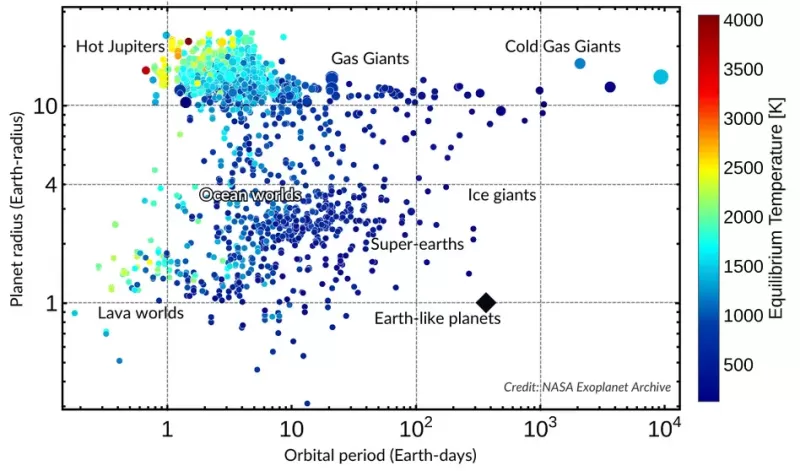
Planetary classification within this scatter plot relies on the fundamental relationship between a planet’s radius and its orbital period, which serves as a proxy for both composition and proximity to the host star. These worlds are categorized into distinct regimes based on their physical scale and thermal environments. Gas Giants dominate the upper regions of the plot, subdivided into “Hot Jupiters” with extremely short orbital periods and “Cold Gas Giants” that reside further from their stars. Below these, “Ice Giants” and “Super-Earths” occupy the intermediate radius scale, representing a transition from gaseous envelopes to more compact structures. The plot further identifies specialized classes like “Ocean Worlds,” which possess significant volatile layers, and “Lava Worlds,” which are small, rocky bodies orbiting so closely to their stars that their surfaces remain molten. Finally, the “Earth-like” regime represents the smallest planets with longer orbital periods, indicating rocky compositions situated within more temperate orbital distances.
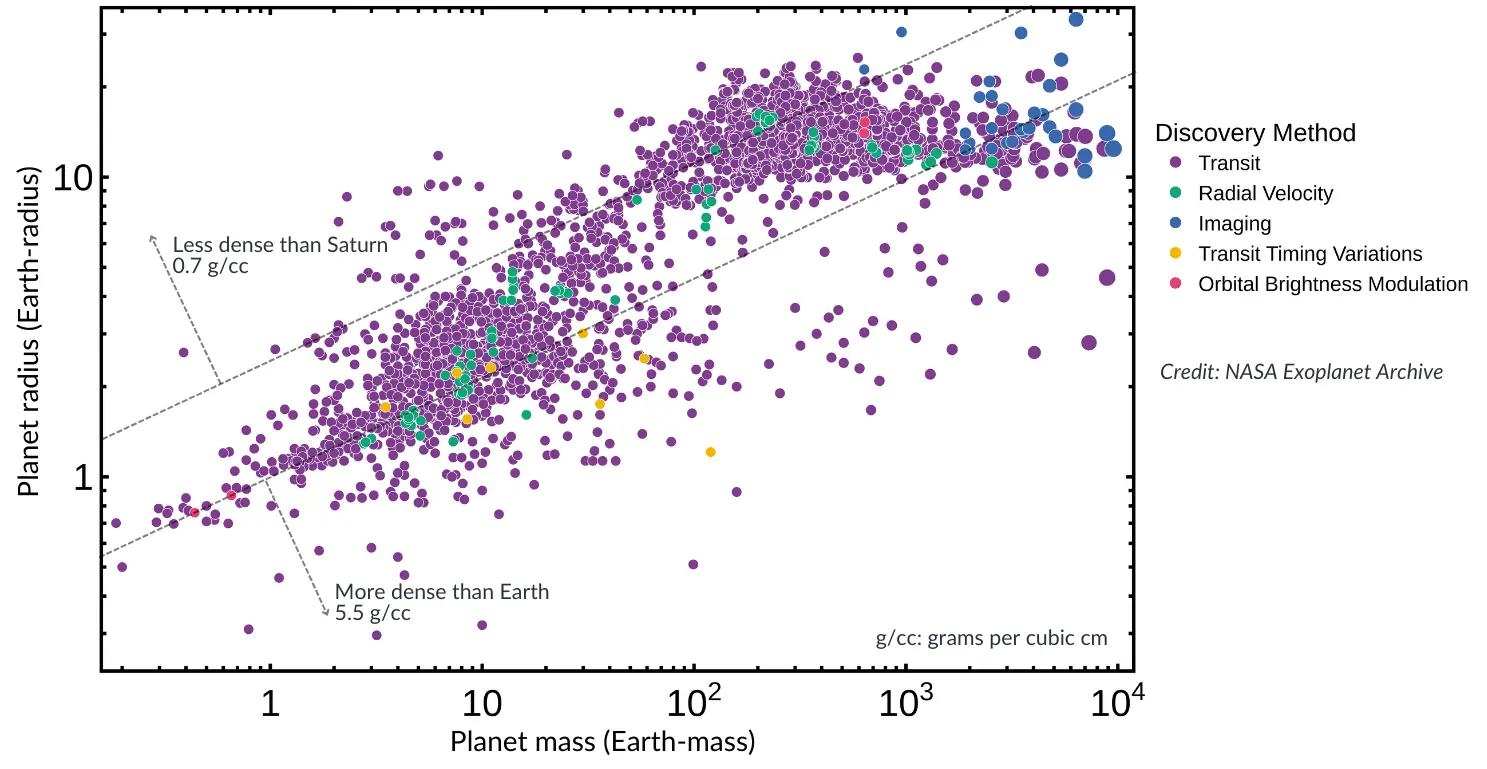
The relationship between planetary mass and radius provides a critical diagnostic for internal composition and density, as illustrated by the distribution of discovery methods. Planets falling along the lower dashed line, characterized by densities greater than 5.5 g/cc (cubic cm) represent rocky, terrestrial compositions similar to or denser than Earth, primarily detected via the transit and radial velocity methods (to be described in another section). Conversely, the upper dashed line denotes a density of 0.7 g/cc, marking the threshold for worlds less dense than Saturn; these are predominantly gas-rich giants discovered through transit observations and direct imaging. The convergence of radial velocity data (green points) and transit data (purple points) in the intermediate mass-radius regime highlights the “Super-Earth” and “Mini-Neptune” populations, where small changes in mass result in significant radius variations due to the presence or absence of a hydrogen-helium envelope. Outliers such as those detected by orbital brightness modulation or transit timing variations further refine these models by providing mass constraints for planets that do not easily fit into standard density profiles.