
This is an old revision of the document!
5.3 Origin of life on earth
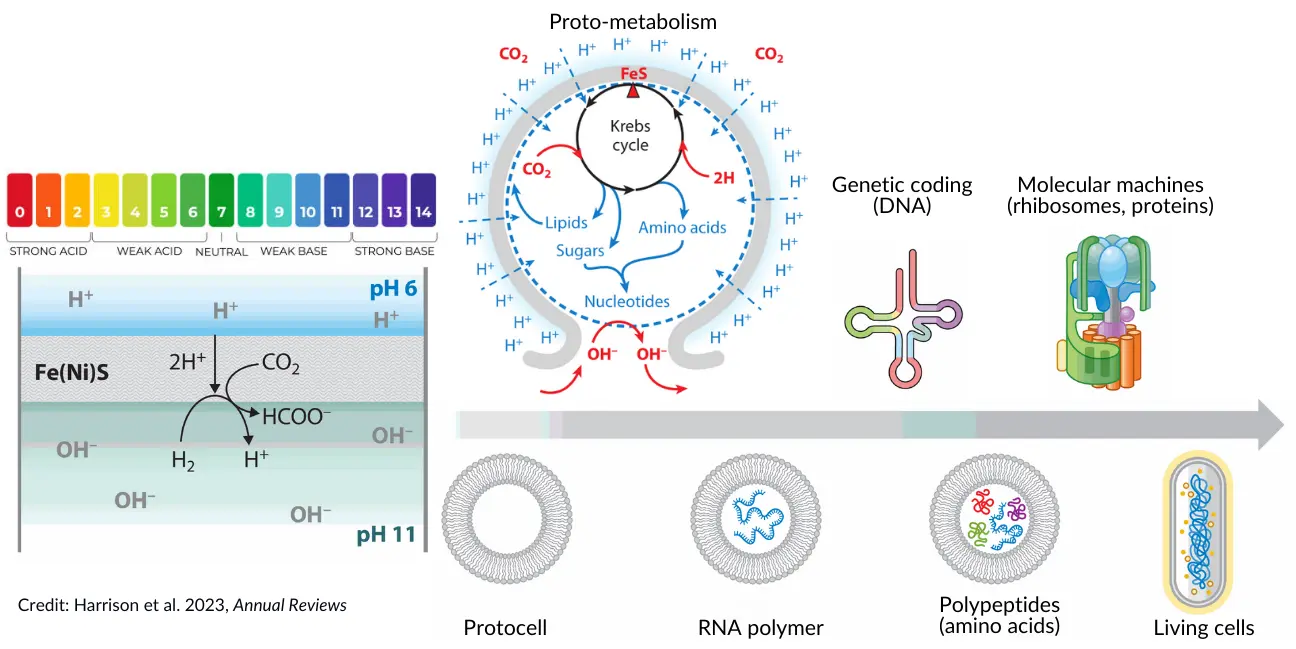
The emergence of complexity began with hydrothermal vents, specifically alkaline vents in the Hadean ocean. These structures featured porous mineral walls that separated alkaline vent fluids from acidic seawater. This pH level difference created natural proton gradients across thin mineral membranes, serving as a primordial power source. Within these microscopic rocky pores, organic molecules became concentrated, leading to the formation of the first protocell. These were not yet alive but represented the first stage of compartmentalization, where fatty acid membranes enclosed chemical reactions. This physical boundary was crucial for maintaining internal stability and preventing the dissipation of life’s ingredients.
Inside these early compartments, the flow of energy driven by proton gradients facilitated the rise of proto-metabolism. This stage involved complex chemical networks where simple molecules transformed into essential building blocks. Specifically, these systems synthesized lipids for membranes, amino acids for proteins, sugars for energy, and nucleotides for genetic material. Central to this phase was the emergence of the Krebs cycle, a universal metabolic engine operating non-enzymatically to recycle carbon. These conditions eventually favored the formation of the RNA polymer. An RNA polymer is a long, chain-like molecule composed of repeating nucleotide units that can both store genetic information and catalyze vital chemical reactions.
As the system evolved, the emergence of genetic coding and DNA provided a more stable and permanent medium for storing biological instructions. Unlike RNA, DNA is chemically resilient, making it an ideal master blueprint for complex systems. This informational leap allowed the protocell to precisely regulate the production of polypeptides and amino acids. Amino acids are the basic units that, when linked in specific sequences, form the structural and functional foundations of all organisms. The transition to a DNA-based system ensured successful metabolic and structural configurations could be passed down, marking the shift from random chemistry to organized biological blueprints.
The final stages involved the assembly of molecular machines, most notably ribosomes and proteins. Ribosomes are the cellular factories that translate genetic code into functional proteins, which then perform the vast majority of biological tasks. These complex machines enabled the protocell to achieve full autonomy, moving beyond mineral-bound chemistry to become independent living cells. These first cells possessed the ability to self-replicate and harvest energy from their environment without relying on external vent structures. This peak in complexity represents the successful transition of matter into life, establishing the foundation for all subsequent biological evolution across our planet Earth today.