
Table of Contents
This is an old revision of the document!
6.2 Rise of the eukaryotes
1. Eukaryotic cells and DNA
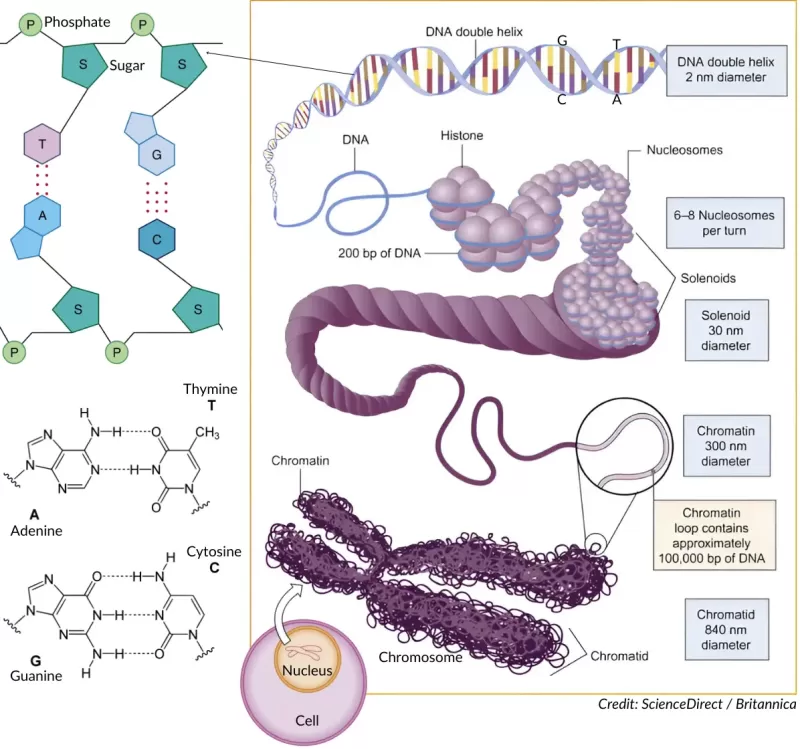
At the most macroscopic level of this biological hierarchy, the diagram depicts a eukaryotic cell containing a distinct nucleus where the genetic blueprint is sequestered. Inside this membrane-bound organelle, the vast library of hereditary information is organized into massive structures known as chromosomes. Each chromosome consists of two identical strands called chromatids, which are joined at a central point and represent the most condensed form of genetic material visible during cell division. These dense, X-shaped bodies serve as the primary transport vehicles for genome distribution. By focusing closer on the chromatid, which measures approximately eight hundred and forty nanometers in diameter, one begins to see the complex layering of the underlying fibers.
Transitioning into the microscopic landscape, the chromatid unravels into expansive chromatin loops, each spanning roughly one hundred thousand base pairs. This loosely packed chromatin further resolves into an intricate three hundred nanometer fiber that maintains the integrity of the genomic sequence. Upon closer magnification, the structure reveals even tighter coils called solenoids, which possess a thirty nanometer diameter. These solenoids are formed by the helical winding of many individual nucleosomes, which resemble beads on a string. Every nucleosome represents the fundamental repeating unit of chromatin, acting as a critical organizational hub that facilitates the extreme compaction required to fit several meters of DNA inside a microscopic cellular environment through metabolic stability.
Penetrating further into the core of the nucleosome, the DNA is seen wrapping around an octameric protein core called a histone. This interaction involves approximately two hundred base pairs of the DNA double helix per unit. Zooming into the helical strands reveals a two nanometer wide spiral composed of a repeating phosphate-sugar backbone. On the interior, specific chemical entities known as nucleobases form complementary pairs that hold the strands together. These bases consist of adenine, thymine, cytosine, and guanine, which are identified by their specific hydrogen bonding patterns. Guanine and cytosine share three bonds, while adenine and thymine share two, ensuring the precise encoding of all life’s complex and biological diversity.