
Table of Contents
3.2. Types of stars
1. Spectral classification
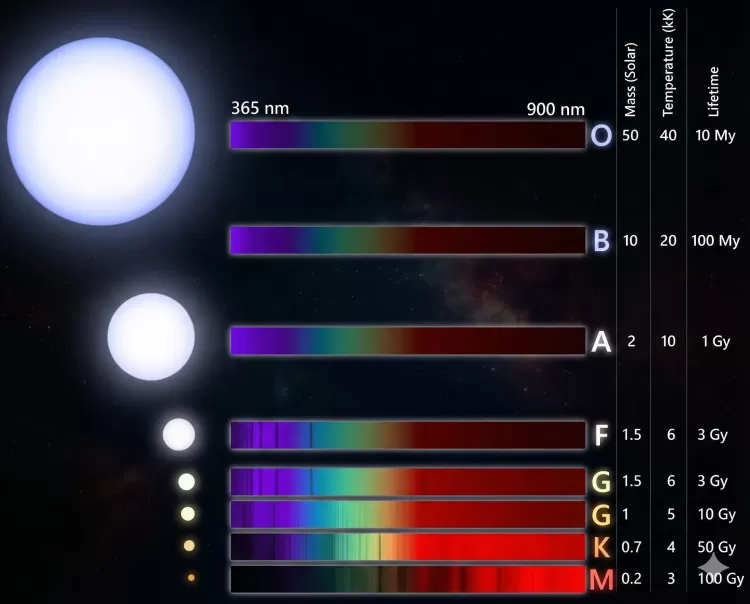
The diagram illustrates the standard stellar classification system—O, B, A, F, G, K, and M—ordered from the most massive and hottest to the least massive and coolest. At the top of the hierarchy are the O and B type stars, which are colossal, luminous blue giants. An O-type star, for instance, boasts a staggering mass 50 times that of our Sun and scorches with surface temperatures around 40,000 Kelvin (40 kK). Because these giants crush and burn through their nuclear fuel at a ferocious rate, they have incredibly brief lifespans; an O-type star lives for only about 10 million years (10 My), while a B-type survives for roughly 100 million years. Their accompanying spectra, spanning from 365 nm to 900 nm, are intensely bright in the shorter, high-energy blue and ultraviolet wavelengths.
Moving down the sequence, we encounter the intermediate-mass stars: types A, F, and G. These stars represent a middle ground in terms of size, temperature, and longevity. An A-type star is about twice the mass of the Sun and burns at 10,000 Kelvin, living for around 1 billion years (1 Gy). As we reach the G-type stars, we find the classification that includes our own Sun. A typical G-type star has a baseline mass of exactly 1 solar mass, a surface temperature of approximately 5,000 Kelvin, and a steady lifespan of about 10 billion years. The spectra for these intermediate stars, particularly A and F types, begin to show distinct dark absorption lines, which become increasingly complex in G-type stars as cooler atmospheres allow a wider variety of atomic transitions to be visible.
At the bottom of the diagram are the K and M type stars, often referred to as orange and red dwarfs, respectively. These are the smallest, coolest, and most abundant stars in the universe. An M-type star possesses a mere fraction of the Sun’s mass—around 0.2 solar masses—and has a comparatively cool surface temperature of 3,000 Kelvin. However, their slow, extremely efficient rate of nuclear fusion grants them staggering longevity. A K-type star can live for 50 billion years, and an M-type red dwarf can burn steadily for 100 billion years (100 Gy), far exceeding the current age of the universe. Their spectra are noticeably darker in the blue regions and brilliantly bright in the red and infrared, characterized by broad absorption bands created by surviving molecules in their relatively cool atmospheres.
2. Stars and humans: birth and death
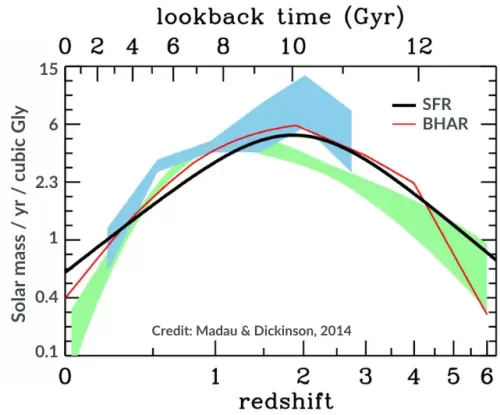
This 2014 Madau & Dickinson diagram illustrates the cosmic history of star formation and black hole growth. The plot utilizes a dual x-axis: the bottom tracks cosmological redshift from 0 to 6, while the top shows corresponding lookback time from 0 to 12 billion years (Gyr). The logarithmic y-axis measures activity density in Solar masses per year per cubic Gigalight-year. Two primary trends are plotted: a thick black line for the Star Formation Rate (SFR) and a red line for the Black Hole Accretion Rate (BHAR). Surrounding shaded regions indicate observational data uncertainties.
The graph’s defining feature is the strongly correlated trajectory of both curves, highlighting a synchronized cosmic evolution. Moving from the early universe toward the present, both the SFR and BHAR rise steeply to a dramatic, shared peak around a redshift of 2. This maximum activity phase, occurring roughly 10 billion years ago, represents the era known as “Cosmic Noon.” Following this incredibly fertile epoch of cosmic birth, both rates undergo a steady, parallel decline toward the present day. This synchronization demonstrates that the fundamental gas reservoirs fueling stellar nurseries simultaneously drove the massive growth of central black holes.
We can draw a striking allegory between this cosmic timeline and human demographic evolution (shown above), specifically the inverse relationship between human fertility and life expectancy. Just as global demographic charts reveal that societies with the highest birth rates paradoxically experience the lowest life expectancies, the universe displays a similarly intertwined fate of creation and consumption. During “Cosmic Noon,” the cosmos was in its own demographic extreme—fervently birthing stars at an unprecedented rate, yet simultaneously feeding the dark, consumptive engines of supermassive black holes. For both mortals and milky ways, explosive, prolific birth is inextricably bound to aggressive consumption and accelerated mortality. As these systems mature—whether a human civilization transitioning to smaller families and longer lives, or our universe settling into a less fertile epoch—the frantic pace of creation wanes, trading the volatile fires of youth for a cooler, more enduring stillness.