
Table of Contents
4.2 Types of planets
1. Classification
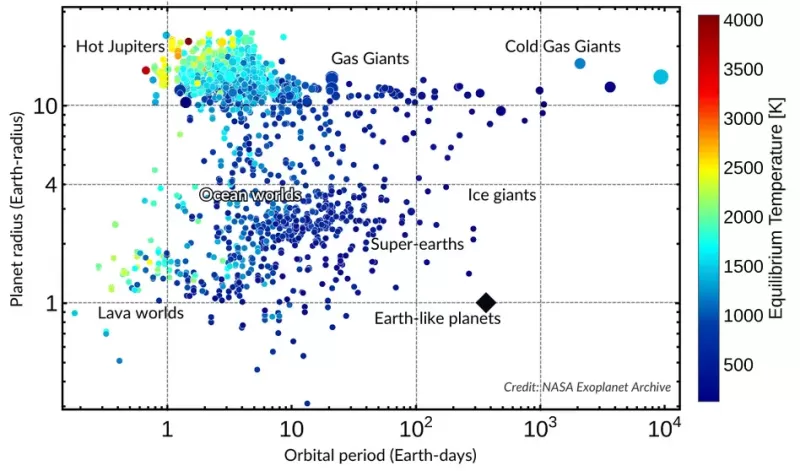
Planetary classification within this scatter plot relies on the fundamental relationship between a planet’s radius and its orbital period, which serves as a proxy for both composition and proximity to the host star. These worlds are categorized into distinct regimes based on their physical scale and thermal environments. Gas Giants dominate the upper regions of the plot, subdivided into “Hot Jupiters” with extremely short orbital periods and “Cold Gas Giants” that reside further from their stars. Below these, “Ice Giants” and “Super-Earths” occupy the intermediate radius scale, representing a transition from gaseous envelopes to more compact structures. The plot further identifies specialized classes like “Ocean Worlds,” which possess significant volatile layers, and “Lava Worlds,” which are small, rocky bodies orbiting so closely to their stars that their surfaces remain molten. Finally, the “Earth-like” regime represents the smallest planets with longer orbital periods, indicating rocky compositions situated within more temperate orbital distances.
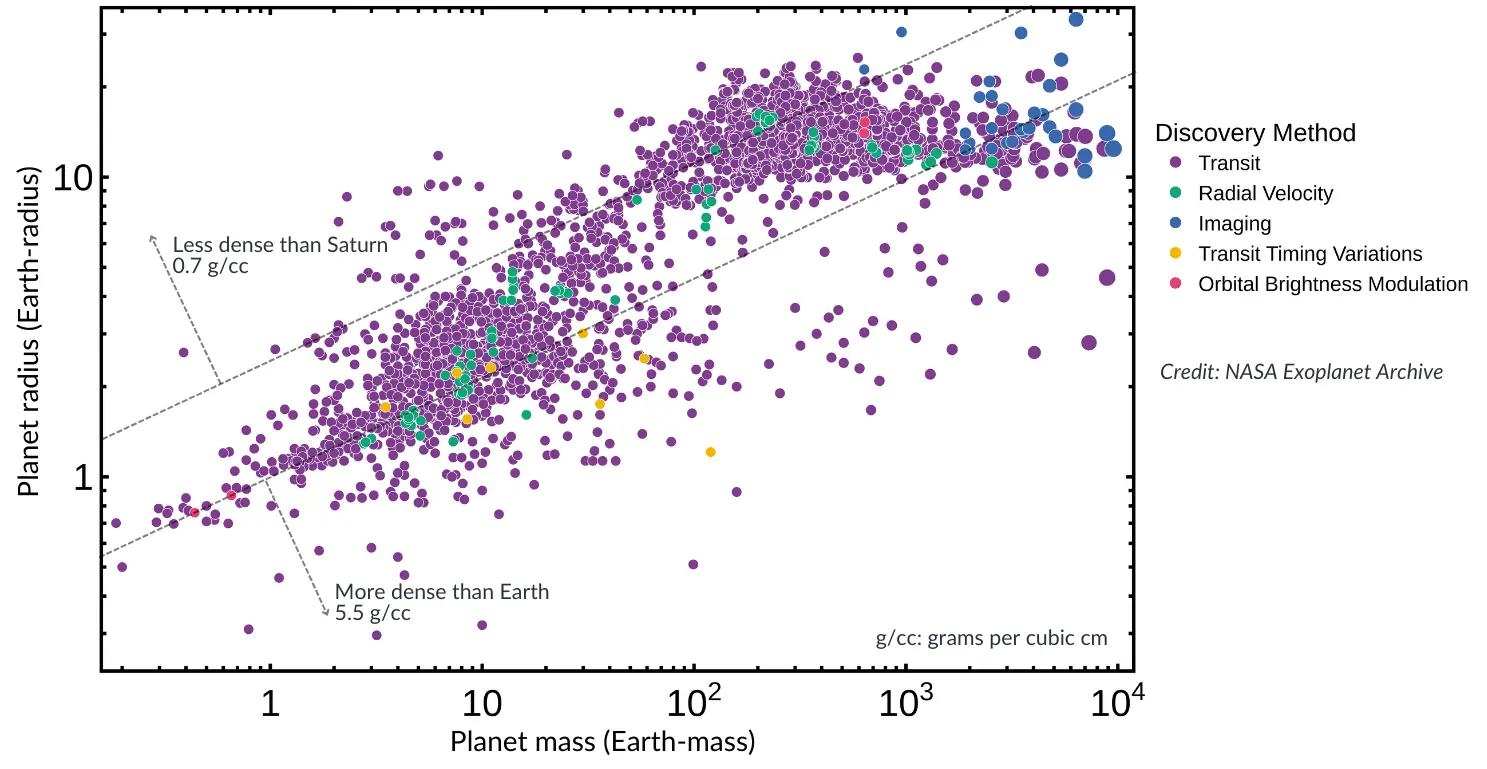
While orbital period and radius define these broad categories, the relationship between planetary mass and radius provides a critical diagnostic for internal composition and density. As illustrated by the distribution of discovery methods, planets falling along the lower dashed line, characterized by densities greater than 5.5 g/cc, represent rocky, terrestrial compositions similar to or denser than Earth. These are primarily detected via the transit and radial velocity methods. Conversely, the upper dashed line denotes a density of 0.7 g/cc, marking the threshold for worlds less dense than Saturn; these are predominantly gas-rich giants discovered through transit observations and direct imaging. The convergence of radial velocity data and transit data in the intermediate mass-radius regime highlights the “Super-Earth” and “Mini-Neptune” populations, where small changes in mass result in significant radius variations due to the presence or absence of a hydrogen-helium envelope. Outliers such as those detected by orbital brightness modulation further refine these models by providing mass constraints for planets that do not easily fit into standard density profiles.
2. Saturn
Understanding the low-density regime of gas giants is best achieved by examining Saturn, which functions as a complex miniature solar system. Characterized by its immense scale and diverse lunar population, Saturn possesses the most intricate ring system in our celestial neighborhood. As the second largest planet, this gas giant is predominantly composed of hydrogen and helium, possessing a density so low it could theoretically float on water. While it lacks a solid surface, its gravitational influence governs more than fifty confirmed moons, ranging from the tiny, ice-covered Enceladus to the massive Titan, which uniquely boasts a dense atmosphere and the potential for life within its subsurface oceans. The surrounding rings, composed of icy and rocky remnants, are meticulously maintained by “shepherding moons” whose gravity keeps the debris in stable circular paths. This dynamic interplay mirrors the fundamental architecture of the larger solar system, making the Saturnian system a primary laboratory for studying planetary evolution and habitability.
3. The Earth
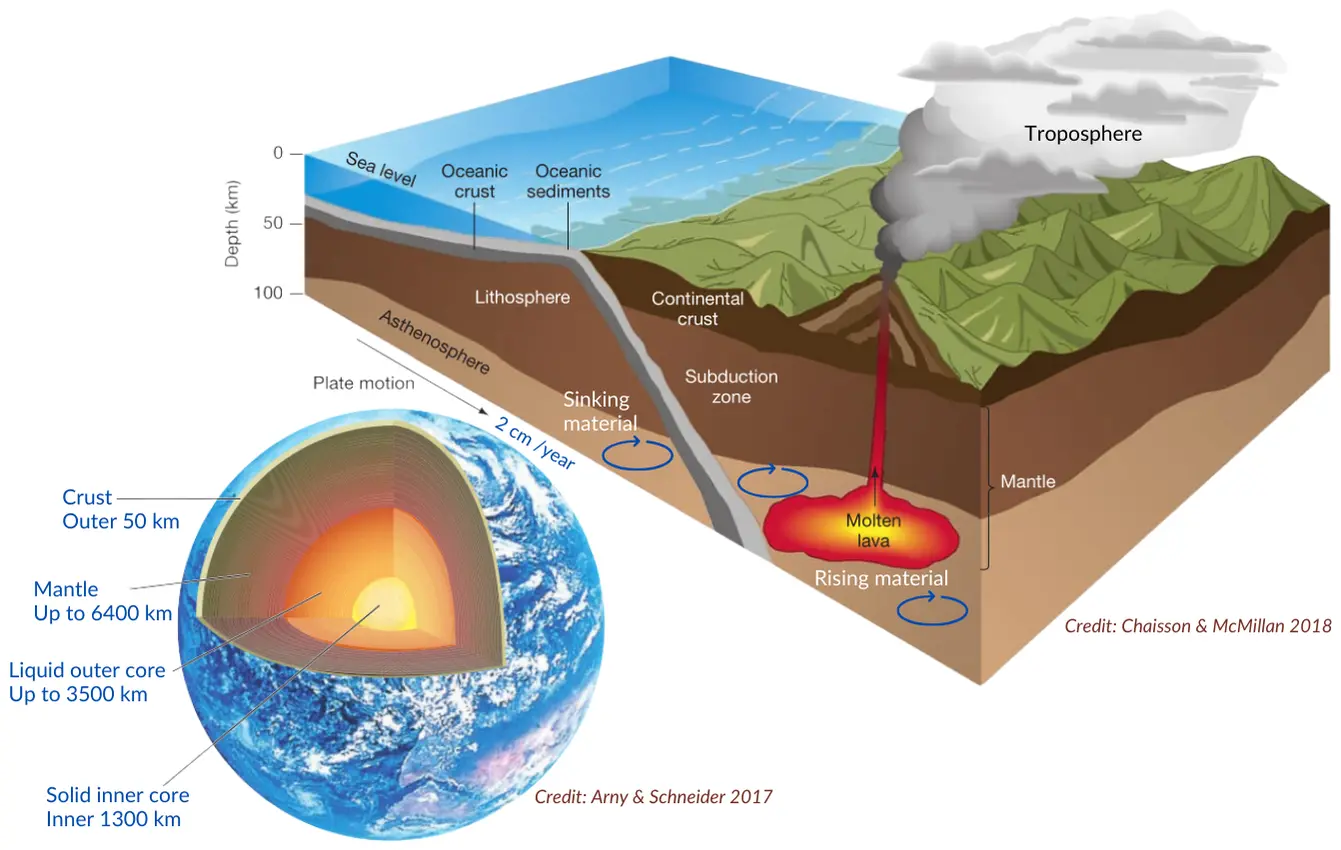
In contrast to the diffuse gas giants, the terrestrial regime is defined by the high-density, differentiated structure of Earth. The internal structure of Earth is composed of a solid inner core, a liquid outer core, and a vast mantle capped by a thin crust. The inner core, a solid sphere of iron and nickel, remains under immense pressure, while the liquid outer core’s motion generates the planet’s magnetic field. Above this, the mantle extends nearly 2900 km deep, providing the thermal energy that drives geological activity. The lithosphere, consisting of the crust and the rigid uppermost mantle, is broken into tectonic plates that float upon the semi-plastic asthenosphere. This ductile layer allows for the slow movement of plates, typically at rates of a few centimeters per year. This structural arrangement is fundamental to maintaining a dynamic planetary surface, as the internal heat from the core and mantle provides the necessary energy to fuel large-scale geological processes over billions of years.
These internal dynamics manifest at the surface through plate tectonics, driven by convection currents within the asthenosphere where heated material rises and cooler material sinks in a continuous cycle. At convergent boundaries, oceanic crust undergoes subduction, sinking into the mantle to be recycled, a process marked by oceanic sediments being dragged into the subduction zone. This recycling periodically renews the crust, while rising molten lava at volcanic arcs creates new continental material, effectively making the surface “alive” through constant geological transformation. The Earth’s surface remains geologically active because the inner core and mantle sustain high temperatures through radioactive decay and primordial heat. This persistent energy flow ensures that the lithosphere is never stagnant, facilitating the long-term carbon cycle and atmospheric stability necessary for a habitable environment.
Over the last billion years, this tectonic history has been defined by the cyclic assembly and dispersal of supercontinents. Approximately 1000 Ma (million years ago), the supercontinent Rodinia dominated the planetary surface before beginning its fragmentation around 750 Ma. As plates drifted across the globe, individual continental fragments eventually converged again, leading to the formation of Pangea roughly 335 Ma. This massive landmass centralized Earth’s crustal plates until approximately 175 Ma, when it began rifting apart to form the modern Atlantic and Indian Oceans. The video model illustrates how rapid subduction zones and mid-ocean ridges have constantly reshaped the seafloor, pushing continents toward their present-day coordinates. This continuous motion highlights the planet’s long-term geological vitality, where continental configurations are merely transient stages in a billion-year cycle of crustal recycling and thermal regulation.
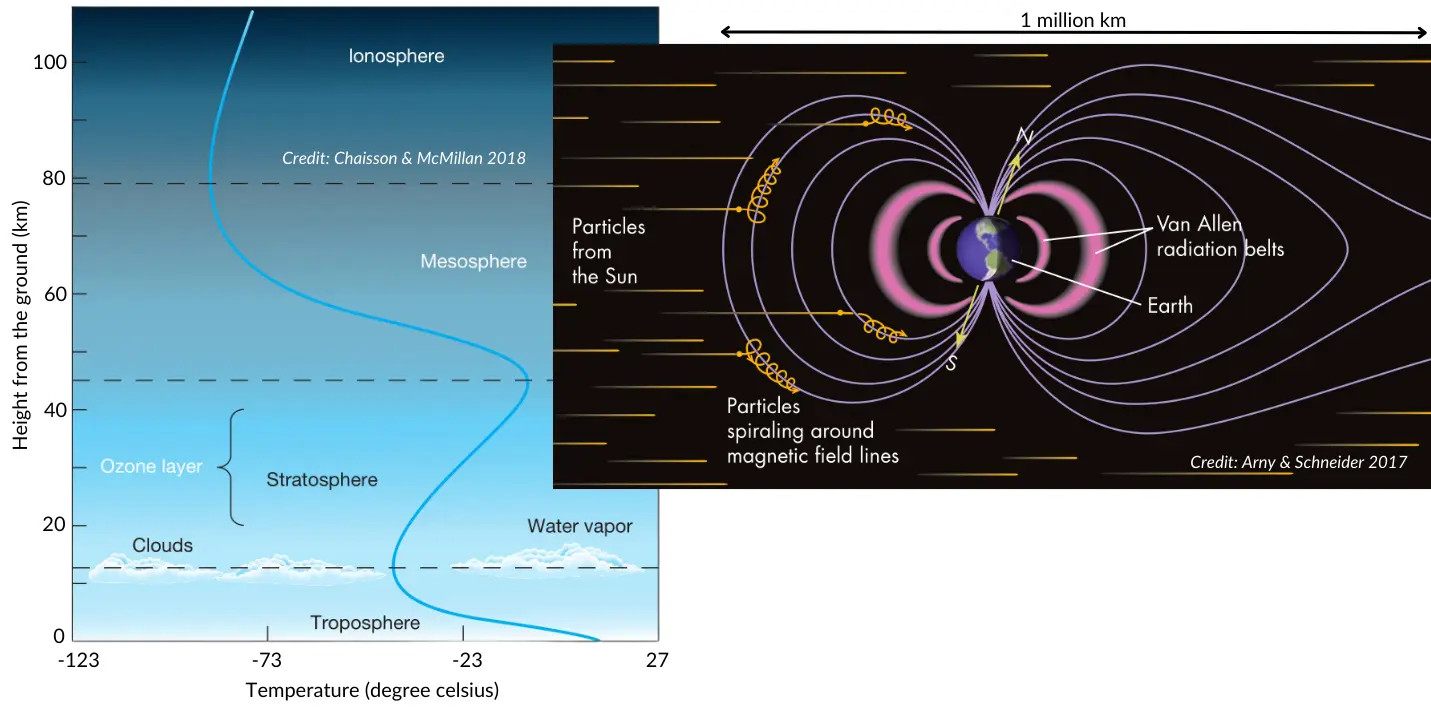
While internal heat drives the surface’s geological life, the resulting atmospheric and magnetic structures protect it from the vacuum of space. The Earth’s atmosphere is organized into distinct thermal layers, starting from the troposphere, which contains the majority of the planet’s water vapor and weather activity. Above the tropopause, the stratosphere exhibits a temperature inversion where heat increases with altitude due to the absorption of ultraviolet radiation by the ozone layer. This protective chemical shield is essential for life, filtering harmful solar rays before they reach the surface. Beyond this, the mesosphere represents the coldest region of the atmosphere, while the ionosphere marks the transition into space, where solar radiation ionizes atmospheric gases. This atmospheric shield is supplemented by a massive magnetosphere, generated by the convective motion of the liquid iron core mentioned previously.
This magnetic field extends over 1 million kilometers into space, forming a teardrop-shaped envelope that deflects high-energy charged particles streaming from the Sun. As solar wind interacts with this field, particles become trapped, spiraling along magnetic field lines and concentrating into the Van Allen radiation belts. These toroidal regions of intense radiation prevent lethal solar plasma from stripping away the atmosphere, effectively sheltering the planet. The field lines converge at the magnetic north and south poles, where particles occasionally leak into the upper atmosphere to create auroras. Without this sustained magnetic protection, the Earth’s surface would be sterilized by solar radiation, and the atmosphere would gradually erode into the vacuum of space, highlighting the critical link between a planet’s deep internal structure and its long-term habitability.