
Table of Contents
4.4 Discovering exoplanets
The quest to identify planets orbiting distant stars has revolutionized modern astrophysics, employing a diverse array of observational techniques to detect these elusive celestial bodies. Astronomers utilize several ingenious methods to uncover exoplanets, including astrometry, which measures minute changes in a star’s position, and gravitational microlensing, which relies on the bending of light by a massive foreground object. Pulsar timing variations also offer a highly sensitive, albeit specialized, means of detection by tracking anomalies in the regular radio pulses emitted by neutron stars. However, while these varied approaches contribute significantly to our understanding of planetary demographics, the overwhelming majority of confirmed exoplanetary discoveries stem from three primary observational techniques. The transit method, the radial velocity technique, and direct imaging stand at the absolute forefront of exoplanetary science. These three foundational strategies provide the most robust data regarding planetary characteristics, serving as the cornerstone for contemporary astronomical investigations.
1. Transit
The transit method, vividly demonstrated in the animation above, relies on a simple geometric alignment between a distant star, its orbiting planet, and our line of sight. When a planetary system is viewed nearly edge-on from Earth, the planet will periodically pass directly in front of its host star. This event, known as a primary transit, blocks a minuscule but measurable fraction of the star’s light, creating a characteristic, temporary dip in the star’s observed brightness. By continuously monitoring the luminosity of stars over extended periods, astronomers can search for these regular, repeating dimming events that signal the clear presence of an orbiting planetary body. When a system hosts multiple transiting planets, the resulting light curve becomes a complex superposition of distinct dimming events. In these cases, the light curve displays multiple series of dips, each varying in depth according to the respective planet’s size and occurring at distinct intervals dictated by their unique orbital periods, occasionally even overlapping during simultaneous transits.
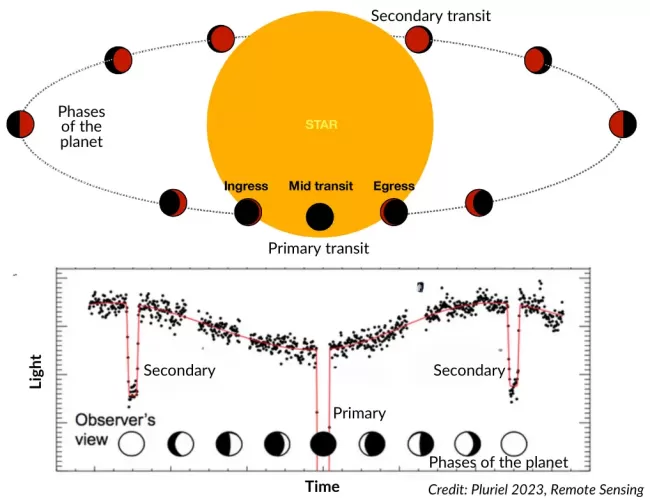
Analyzing the resulting light curve diagram reveals critical details about the planetary system beyond just its existence. While the prominent dip represents the primary transit, a much shallower secondary dip occurs when the planet passes behind the host star, an event known as a secondary transit or eclipse. Observing this secondary transit allows astronomers to isolate and measure the thermal emission and reflected light from the planet’s day side, offering glimpses into its atmospheric temperature and composition.
During the primary transit, scientists can directly measure the planet’s physical size, or radius, based on the exact percentage of starlight blocked relative to the star’s size. Furthermore, the precise time elapsed between successive primary transits dictates the planet’s orbital period. This technique has proven to be the most phenomenally successful method of exoplanet discovery to date; unlike techniques that require painstaking, individualized focus on a single star, transit surveys can simultaneously monitor the brightness of hundreds of thousands of stars across wide fields of view, yielding massive hauls of confirmed planets.
2. Radial velocity
Contrary to the simplified model of a planet orbiting a perfectly stationary star, both bodies actually orbit a common center of mass, known as the barycenter. This concept can be visualized using the analogy of a playground seesaw. If two individuals of significantly different weights attempt to balance on a seesaw, the fulcrum—or the center of mass—must be placed much closer to the heavier person. In a planetary system, the star is vastly more massive than the planet, meaning their shared center of mass is located extremely close to the star’s center, often just beneath its surface. As the planet travels in its large orbit, the star simultaneously moves in a much smaller orbit around this exact same balance point, creating a slight, predictable wobble in the star’s motion.
This gravitational wobble is the foundational mechanism behind the radial velocity technique, often referred to as Doppler spectroscopy. As vividly illustrated in the referenced animation, shifting our perspective to an edge-on view of the system reveals exactly how this orbital dance translates into measurable data. As the star revolves around the barycenter, it periodically moves toward and away from an observer on Earth. This movement alters the star’s light through the Doppler effect, a phenomenon the visual model elegantly represents with an oscillating wave. When the star’s orbit carries it away from us, its light waves stretch and shift toward the red end of the electromagnetic spectrum, depicted by the red crests of the animated wave. Conversely, as the star swings back and is pulled slightly toward our solar system, the light waves are compressed, shifting toward the blue end, matching the wave’s blue troughs. By tracking this continuous cycle of color variations, astronomers can confidently infer the presence of an unseen planetary companion.
To capture these microscopic shifts in starlight, observatories utilize highly sensitive instruments known as spectrographs (introduced in Chapter 0). When starlight enters a telescope, it is fed into the spectrograph, which acts like an extremely advanced prism, separating the light into its component colors and revealing a detailed spectrum. Within this spectrum are dark absorption lines created by specific chemical elements in the star’s atmosphere absorbing certain wavelengths of light. As the star wobbles, astronomers observe these entire sets of dark lines shifting back and forth along the spectrum over time. The direct parameters measured during this observation are the precise velocity of the star’s movement toward and away from Earth, and the exact duration it takes to complete one full cycle of shifts. From these direct measurements, scientists can calculate the planet’s orbital period and determine a lower limit for the planet’s mass, providing vital clues about its physical scale and gravitational influence.
3. Direct imaging

Direct imaging represents one of the most technologically demanding methods of exoplanet discovery, involving the capture of actual visual data rather than inferring a planet’s presence through stellar influence. The primary challenge is the overwhelming luminosity of the host star, which typically outshines its planetary companions by factors of millions or billions. To overcome this immense disparity, astronomers utilize a specialized instrument called a coronagraph. As illustrated in the provided visual sequence, the coronagraph physically blocks the central star’s blinding light—marked by the central yellow star—creating an artificial eclipse. This precise light suppression reveals the much fainter planetary bodies that would otherwise remain completely hidden within the stellar glare.
The resulting observations, such as the multi-year timelapse depicted, provide profound insights into the dynamic nature of these distant solar systems. Interestingly, while the transit and radial velocity techniques fundamentally rely on a planetary system being oriented nearly edge-on relative to Earth, direct imaging is uniquely suited for systems viewed from a face-on perspective. This top-down orientation ensures the planets remain visibly separated from the star’s central glare throughout their entire orbit, rather than periodically passing in front of or behind the host star. By tracking these distinct points of light over time from this vantage point, astronomers can directly observe the planets progressing along their orbits, which are often vast and measured on a scale of dozens of astronomical units. This technique is particularly effective for identifying young, massive gas giants situated far from their host stars. Furthermore, because direct imaging captures the actual photons reflected by the planets themselves, scientists can directly analyze this light to determine atmospheric composition and thermal properties, representing a crucial step toward fully characterizing alien worlds.