
Table of Contents
5.1 Periodic Table
1. Interactive table
This table is interactive: click any element to open a detailed panel showing its atomic number, mass, electron configuration, phase at standard conditions, and a live atomic animation with orbiting electrons and a glowing nucleus. You can also filter by origin — click “Neutron Star Mergers,” for instance, and the table dims every element except those forged in a kilonova, a technique confirmed observationally by the gravitational-wave event GW170817 in 2017. As you work through AST100, return to this table often. Every element you encounter in a lecture — from the oxygen in a molecular cloud to the lead in a dying star’s core — has its address here.
The periodic table is one of the most powerful maps in all of science — a single chart that organises every known atom in the universe by the number of protons in its nucleus (the atomic number, Z) and by the arrangement of its electrons. Reading left to right across a period, each step adds one proton; reading top to bottom down a group, each step adds a new shell of electrons. The result is a profound regularity: elements in the same column share chemical personalities. Hydrogen sits alone at the top-left, the universe’s most abundant atom, while the noble gases stand aloof at the far right, chemically inert and serene.
What makes this table extraordinary for this course is that it encodes where each element was born. The colour-coded origin legend reveals seven distinct forges: the Big Bang produced hydrogen and helium in the first fifteen minutes; small and massive stars built everything from carbon to iron through nuclear fusion; supernovae and neutron-star mergers — violent, cataclysmic events — forged the heavy elements like gold, platinum, and uranium in seconds. Even the keyboard you type on, the calcium in your bones, the iodine in your thyroid — each atom carries the memory of a specific astrophysical event billions of years in the past.
2. Origin of heavy elements
A massive star begins its life in hydrostatic equilibrium, balancing the relentless inward pull of gravity with the outward radiation pressure generated by nuclear fusion. In its core, hydrogen fuses into helium at temperatures of at least 10 million kelvins, a stable phase that lasts for millions of years. Eventually, the core exhausts its hydrogen fuel, causing outward pressure to drop and gravity to momentarily win. As the core contracts, gravitational energy converts to heat, driving temperatures high enough to ignite a shell of hydrogen just outside the now-helium core. This intense shell-burning causes the star’s outer envelope to drastically expand and cool, transforming the massive star into a bloated red supergiant.
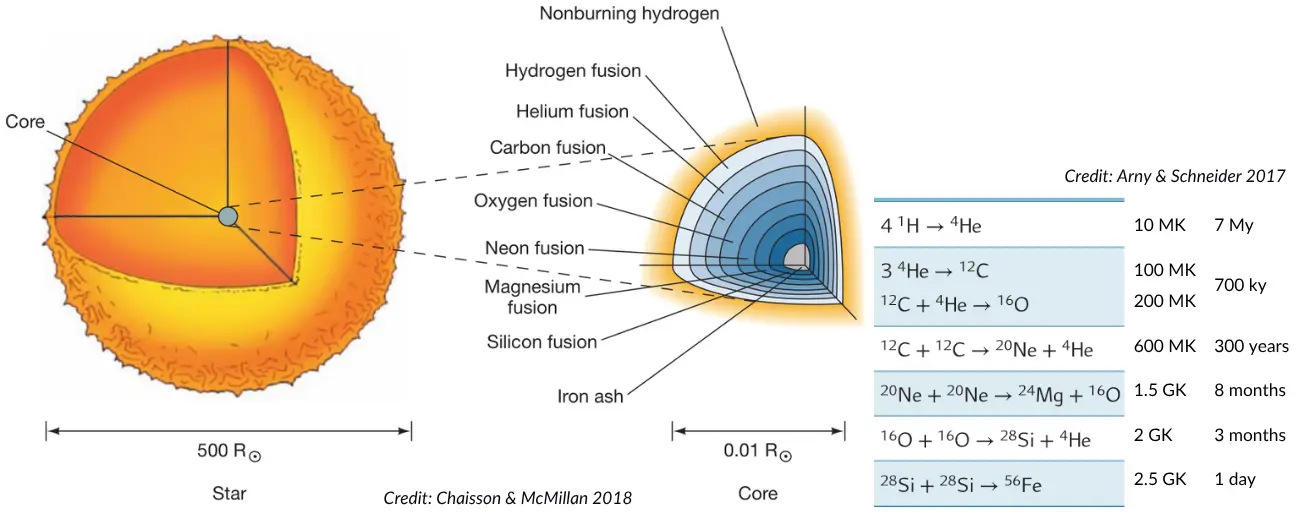
Deep within the red supergiant, the contracting helium core eventually reaches 100 million kelvins, igniting the triple-alpha process to forge carbon. This establishes a pattern: as each fuel is exhausted at the center, the core contracts, heats up, and ignites the next heavier element, while previous fuels continue to burn in concentric shells above, building an “onion-like” layered structure. The deeper shells burn with terrifying speed as temperatures climb. For a massive star 20 times the mass of our Sun, carbon fusion at 600 million kelvins exhausts itself in about 1,000 years, oxygen fusion lasts for just one year, and the desperate stage of silicon fusion persists for only about one week. This rapid nucleosynthesis culminates in the formation of an inert iron core, which is so tightly bound that it cannot undergo fusion to produce energy.
When the iron core grows too massive to support its own weight, it collapses in a fraction of a second, driving central temperatures to nearly 10 billion kelvins. This intense heat triggers photodisintegration, breaking iron nuclei apart and accelerating the catastrophic collapse until the core rebounds at nuclear densities. This rebound sends a violently energetic shockwave outward, blasting the star’s enriched outer layers into interstellar space in a core-collapse supernova. During the first 15 minutes of this staggeringly powerful explosion, an immense flood of free neutrons bombards the expanding nuclei. Through this rapid neutron capture, or r-process, the supernova synthesizes the heaviest elements in the universe—such as silver, gold, uranium, and plutonium—seeding the cosmos with the chemical complexity required for future worlds.
When a massive star reaches the end of its life, its iron core collapses and violently rebounds, triggering a catastrophic core-collapse supernova. During the first 15 minutes of this staggering explosion, the immense violence breaks apart existing heavy nuclei, releasing a dramatic flood of free neutrons. In this extreme environment, the rate of neutron capture is so extraordinarily high that intermediate-weight and unstable nuclei are forcefully jammed with multiple neutrons before they have any time to radioactively decay. This mechanism, known as the r-process (rapid neutron capture), synthesizes the universe’s heaviest and most valuable elements—including silver, gold, uranium, and plutonium—which cannot be formed during normal stellar fusion. The explosion then blasts these newly forged elements into interstellar space at tens of thousands of kilometers per second, enriching the cosmos.
Beyond the deaths of single massive stars, other violent cosmic interactions also serve as crucial forges for heavy elements. Astronomers now believe that considerable amounts of gold and other heavy elements may be synthesized during the catastrophic collision and merger of two ultradense neutron stars, events that are also thought to be the source of some gamma-ray bursts. Additionally, in binary systems where a carbon-oxygen white dwarf steals too much matter from a companion star, it can become unstable and undergo a runaway nuclear detonation. This triggers a Type Ia supernova, an explosion that completely incinerates the white dwarf and ejects particularly large quantities of iron and other heavy elements into the galaxy.