Table of Contents
This is an old revision of the document!
5.1 Periodic Table
1. Interactive table
This table is interactive: click any element to open a detailed panel showing its atomic number, mass, electron configuration, phase at standard conditions, and a live atomic animation with orbiting electrons and a glowing nucleus. You can also filter by origin — click “Neutron Star Mergers,” for instance, and the table dims every element except those forged in a kilonova, a technique confirmed observationally by the gravitational-wave event GW170817 in 2017. As you work through AST100, return to this table often. Every element you encounter in a lecture — from the oxygen in a molecular cloud to the lead in a dying star’s core — has its address here.
The periodic table is one of the most powerful maps in all of science — a single chart that organises every known atom in the universe by the number of protons in its nucleus (the atomic number, Z) and by the arrangement of its electrons. Reading left to right across a period, each step adds one proton; reading top to bottom down a group, each step adds a new shell of electrons. The result is a profound regularity: elements in the same column share chemical personalities. Hydrogen sits alone at the top-left, the universe’s most abundant atom, while the noble gases stand aloof at the far right, chemically inert and serene.
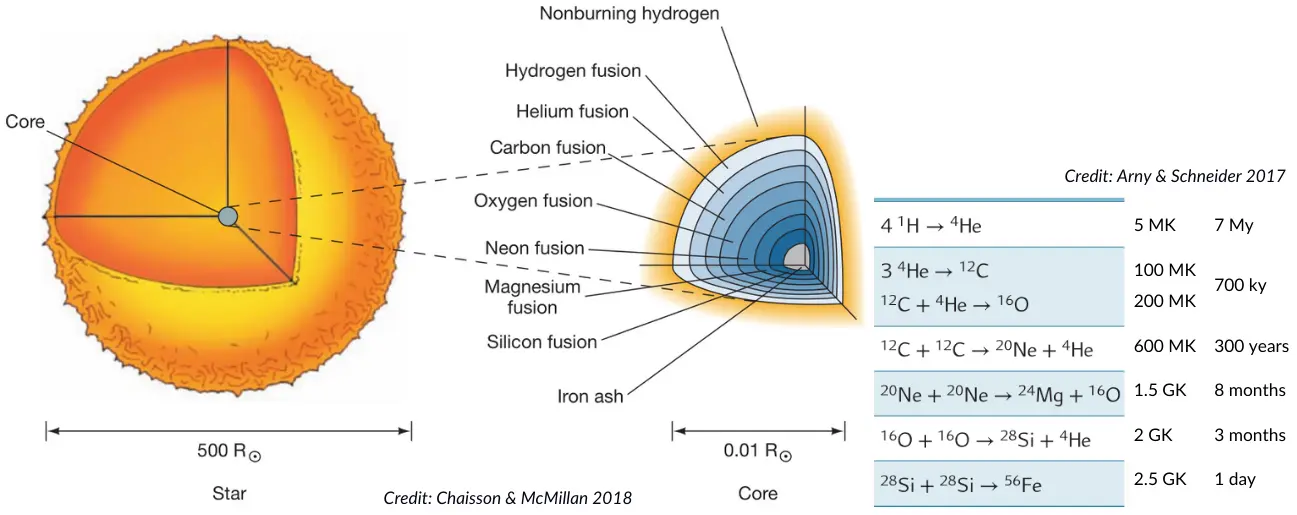
What makes this table extraordinary for this course is that it encodes where each element was born. The colour-coded origin legend reveals seven distinct forges: the Big Bang produced hydrogen and helium in the first fifteen minutes; small and massive stars built everything from carbon to iron through nuclear fusion; supernovae and neutron-star mergers — violent, cataclysmic events — forged the heavy elements like gold, platinum, and uranium in seconds. Even the keyboard you type on, the calcium in your bones, the iodine in your thyroid — each atom carries the memory of a specific astrophysical event billions of years in the past.
2. Origin of heavy elements