
Table of Contents
This is an old revision of the document!
5.1 Periodic Table
1. Interactive table
This table is interactive: click any element to open a detailed panel showing its atomic number, mass, electron configuration, phase at standard conditions, and a live atomic animation with orbiting electrons and a glowing nucleus. You can also filter by origin — click “Neutron Star Mergers,” for instance, and the table dims every element except those forged in a kilonova, a technique confirmed observationally by the gravitational-wave event GW170817 in 2017. As you work through AST100, return to this table often. Every element you encounter in a lecture — from the oxygen in a molecular cloud to the lead in a dying star’s core — has its address here.
The periodic table is one of the most powerful maps in all of science — a single chart that organises every known atom in the universe by the number of protons in its nucleus (the atomic number, Z) and by the arrangement of its electrons. Reading left to right across a period, each step adds one proton; reading top to bottom down a group, each step adds a new shell of electrons. The result is a profound regularity: elements in the same column share chemical personalities. Hydrogen sits alone at the top-left, the universe’s most abundant atom, while the noble gases stand aloof at the far right, chemically inert and serene.
What makes this table extraordinary for this course is that it encodes where each element was born. The colour-coded origin legend reveals seven distinct forges: the Big Bang produced hydrogen and helium in the first fifteen minutes; small and massive stars built everything from carbon to iron through nuclear fusion; supernovae and neutron-star mergers — violent, cataclysmic events — forged the heavy elements like gold, platinum, and uranium in seconds. Even the keyboard you type on, the calcium in your bones, the iodine in your thyroid — each atom carries the memory of a specific astrophysical event billions of years in the past.
2. Origin of heavy elements
A massive star begins its life in hydrostatic equilibrium — gravity pulling inward, radiation pressure pushing outward, a balance maintained by hydrogen fusion in the core at roughly 5 million kelvin. Four hydrogen nuclei fuse into a single helium nucleus, releasing the energy that holds the star up. This stage is the longest, lasting millions of years. But hydrogen is finite. When the core exhausts its hydrogen fuel, the outward pressure drops and gravity wins momentarily — the core begins to contract. As it contracts, gravitational energy converts to heat, and the core temperature rises. This rising temperature ignites a shell of hydrogen just outside the now-helium core, restoring pressure and actually causing the outer envelope to puff outward. The star becomes a red giant, bloated on the outside yet quietly contracting within.
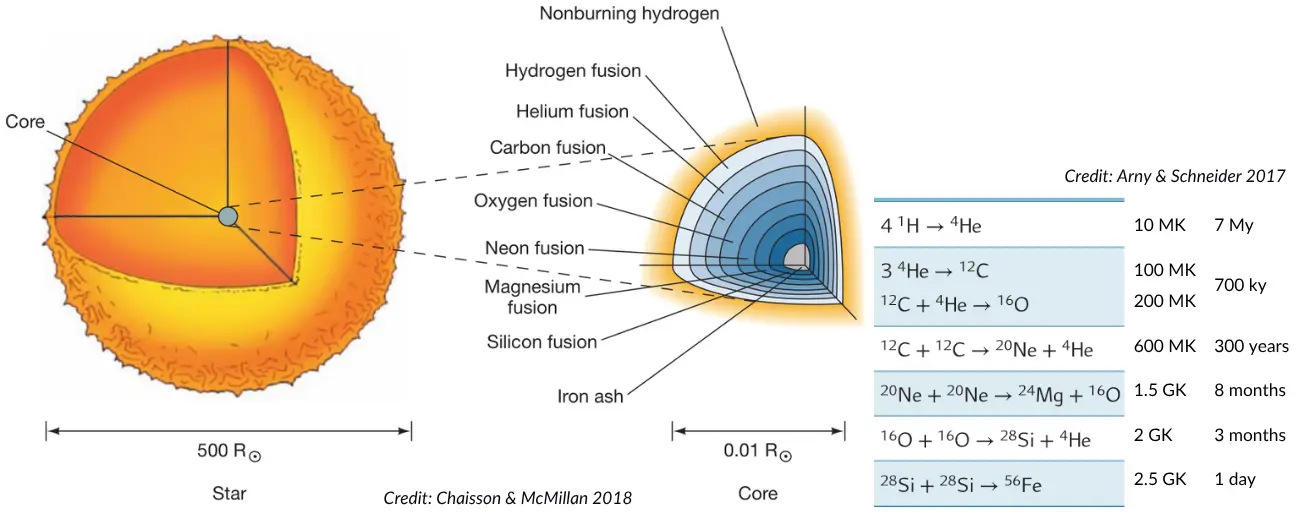
The contracting helium core keeps heating until it crosses 100 million kelvin, the ignition threshold for helium fusion. Now three helium nuclei collide in the triple-alpha process to forge carbon, and at 200 million kelvin, carbon and helium combine further to produce oxygen. The pattern is now established: when a fuel is exhausted at the center, the core contracts, heats up, and ignites the next heavier fuel, while the previous fuel continues burning in a shell above it. Each new burning stage adds another shell around the last, and the star builds its layered onion structure entirely from the inside out — not by design, but by the inexorable logic of gravity and nuclear physics working in alternation.
The deeper shells burn with terrifying speed as temperatures climb ever higher. Carbon fusion ignites at 600 million kelvin and exhausts itself in a mere 300 years. Neon fusion follows at 1.5 billion kelvin, lasting only eight months. Oxygen burning at 2 billion kelvin persists for just three months. Finally, silicon fusion at 2.5 billion kelvin — the hottest and most desperate stage — lasts a single day, building iron from colliding silicon nuclei. Iron is the end of the road: its nucleus is so tightly bound that fusing it further would consume energy rather than release it. The star has written its own death sentence. At its heart sits an iron core, inert and growing, surrounded by concentric shells of progressively lighter burning fuels — a structure so compact that the entire nuclear onion spans barely 0.01 solar radii, while the star itself stretches 500 solar radii from core to surface.
When the iron core finally reaches a critical mass, electron pressure can no longer resist gravity and it collapses in less than a second. The outer shells, still laden with carbon, oxygen, neon, magnesium, and silicon — the products of millions of years of nuclear labour — are violently ejected into interstellar space by the resulting shockwave. This is the supernova. But the explosion does more than disperse existing elements: the collapsing core releases an enormous neutron flood that bombards surrounding nuclei far faster than those nuclei can decay, a process called rapid neutron capture, or the r-process. In this neutron storm lasting mere seconds, nuclei climb the periodic table well beyond iron, producing bromine, iodine, barium, and many others. The supernova then blasts all of this enriched material outward at a significant fraction of the speed of light, seeding the interstellar medium with the entire periodic table up to uranium.
Yet even supernovae do not tell the whole story. Some of the heaviest elements — gold, platinum, and uranium — are forged most abundantly not in stellar explosions but in the collision of two neutron stars, a kilonova. When these city-sized remnants of previous supernovae spiral together under gravity and finally merge, the neutron density is so extreme that the r-process operates at an intensity no single supernova can match, producing vast quantities of heavy elements in milliseconds — confirmed observationally by the gravitational-wave detection GW170817 in 2017. Meanwhile, three light elements — lithium, beryllium, and boron — take an entirely different path. Stellar interiors are too hot to preserve these fragile nuclei, so instead they are built in the cold of interstellar space, when high-energy cosmic rays traveling near the speed of light smash into heavier atoms like carbon and oxygen, chipping off fragments in a process called spallation. The periodic table is thus not the product of a single forge, but of seven distinct cosmic crucibles operating across billions of years of universal history.