
5.2 Formation of oceans and atmospheres
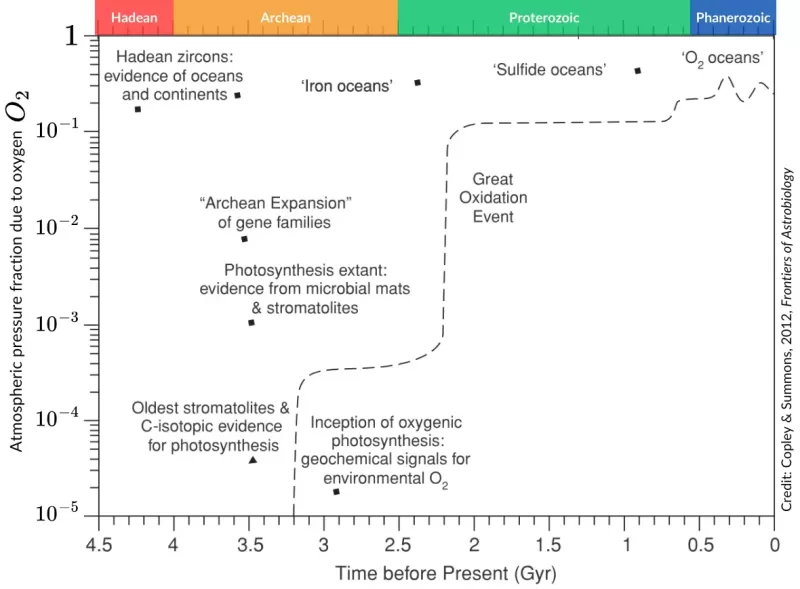
The initial formation of Earth’s atmosphere and oceans was a direct consequence of the planet’s violent birth and subsequent planetary differentiation during the Hadean Eon. While the surface was once thought to be a hellish landscape of molten rock, the discovery of Hadean zircons—tiny, resilient crystals dating back to 4.4 billion years—suggests that liquid water may have existed much earlier than previously believed. These crystals contain isotopic signatures indicating that the Earth cooled sufficiently for torrential rains to precipitate from a primary atmosphere thick with water vapor, carbon dioxide, and nitrogen released via volcanic outgassing. This epic precipitation eventually filled the lowest basins of the crust, forming the first primordial oceans and setting the stage for a world dominated by liquid water and a dense, heat-trapping gaseous envelope.
The second stage of evolution was characterized by a planet-wide biological phenomenon where the primordial oceans became a vast, interconnected laboratory for life. During this era, much of the global ocean was likely covered by a continuous, slimy film of microorganisms, a striking fact considering that this single bacterial colony effectively spanned the entire planet. These early inhabitants were anaerobic, meaning they thrived in environments devoid of free oxygen and relied on chemical energy from volcanic vents or the breakdown of minerals. The initial oceans were predominantly iron-rich, as dissolved ferrous iron remained stable in the absence of oxygen. In this anaerobic world, the atmosphere was a mix of nitrogen and methane, and the oceans were dominated by sulfur-cycling bacteria that maintained a delicate, low-energy equilibrium.
The transition to the third stage began approximately 3.2 billion years ago, marked by the appearance of stromatolites—layered sedimentary structures formed by the trapping and binding of mineral grains within the biofilms of cyanobacteria. As indicated by the initial small rise in the dashed line of the geological record, these organisms began performing oxygenic photosynthesis. However, this biological innovation was essentially a suicide mission; the byproduct of their survival was oxygen, a highly reactive and toxic gas to the anaerobic organisms of the time. Like a mirror to modern industrial society’s impact on the global climate, these early cyanobacteria were inadvertently polluting their world with a “poison” that was fundamentally incompatible with their own internal chemistry and the sulfide-rich oceans that would eventually emerge.
The fourth stage, occurring approximately 2.3 billion years ago, represents the Great Oxidation Event, where oxygen levels rose sharply as the planet’s natural “sinks” became saturated. For eons, the iron-rich oceans had acted as a chemical sponge, but as oxygen production increased, the environment transitioned into a sulfide-rich, or euxinic, state. These sulfide oceans were characterized by high levels of hydrogen sulfide, which further complicated the survival of early life. Eventually, even these sinks were overwhelmed, and oxygen began to flood the atmosphere. This transition allowed for the rise of aerobic life—organisms that utilize oxygen for respiration—which is a much more efficient process for harvesting energy. This shift also facilitated the formation of the ozone layer, providing a critical shield against lethal ultraviolet radiation from the Sun.
In the final stage, the atmospheric and oceanic systems reached a state of relative equilibrium that permitted the explosion of complex, multicellular biological diversity. Oxygen concentrations eventually stabilized near the modern level of twenty-one percent, fueling the high-energy demands of animals and the eventual conquest of land. The interaction between the biosphere, the hydrosphere, and the atmosphere created a self-regulating system that maintains the Goldilocks conditions we inhabit today. This history serves as a profound reminder that life is not merely a passenger on Earth but an active, and sometimes dangerous, agent of planetary change. The transition from a sulfide-choked, anaerobic world to our current oxygen-rich paradise was bought at the cost of an ancient global extinction, a narrative that underscores the precarious balance of our cosmic home.