
Table of Contents
6.3 Mass extinctions
1. Extinction patterns
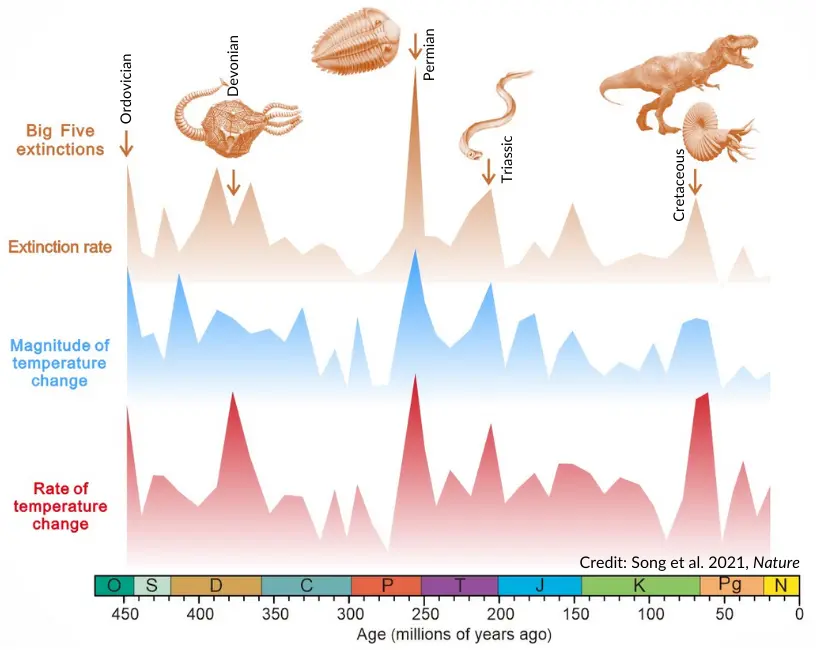
The history of life on Earth is punctuated by five catastrophic episodes known as the Big Five mass extinctions. These biological crises are quantified by the extinction rate, a parameter representing the percentage of species lost during a specific geological interval. This metric peaks when extreme environmental stressors overwhelm the resilience of global ecosystems. The first major event, the Late Ordovician extinction approximately 444 million years ago, perfectly illustrates this. Triggered by a rapid shift into a severe icehouse climate, intense glaciation caused sea levels to plummet. This destroyed shallow marine habitats, driving an extinction rate that decimated marine life.
To understand these crises, scientists analyze the magnitude of temperature change, which measures the total degree of thermal deviation from established planetary baselines. This parameter captures whether the Earth experienced profound warming or intense cooling over extended periods, altering ocean chemistry and making habitats inhospitable. The Late Devonian extinction, roughly 372 million years ago, occurred alongside significant fluctuations in this magnitude parameter within an overall icehouse phase. Driven by nutrient runoff, marine anoxia, and prolonged cooling trends, this event resulted in a moderate but sustained extinction rate that systematically devastated coral reef ecosystems and numerous marine species over millions of years.
While absolute thermal shifts are significant, the rate of temperature change frequently proves to be the most lethal factor. This metric measures how rapidly temperatures fluctuate, determining if biological populations have time to adapt or migrate. Rapid spikes outpace evolutionary responses, causing systemic ecological collapse. This is strikingly evident during the End-Permian extinction, 252 million years ago. Ignited by immense volcanic eruptions in the Siberian Traps, the planet endured an unprecedented spike in the rate of temperature warming. This extreme acceleration into a sweltering greenhouse state caused the most catastrophic biodiversity loss in Earth’s history, eliminating ninety-six percent of species.
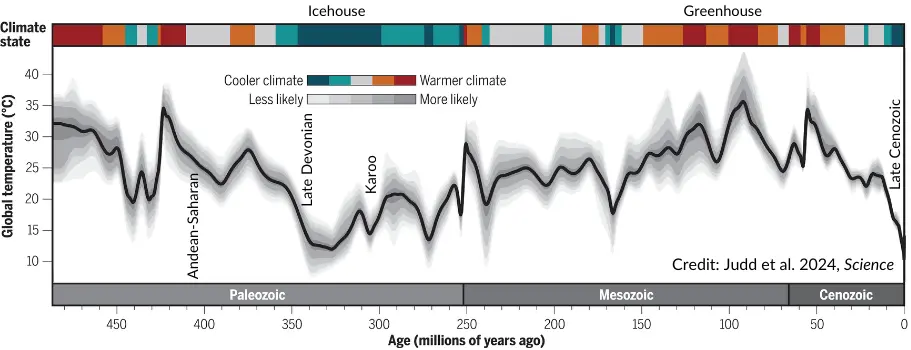
A broader perspective is provided by the global temperature versus age plot, which charts the Earth’s long-term climate state, differentiating between prolonged icehouse and greenhouse periods. This longitudinal graph reveals absolute global temperatures ranging from roughly ten to thirty-five degrees Celsius over half a billion years, illustrating the overarching climate baseline before extinction triggers occurred. During the End-Triassic extinction, about 201 million years ago, the planet transitioned deeply into a warm greenhouse state. Fueled by vast volcanic activity in the Central Atlantic Magmatic Province, the resulting high rate of temperature change lethally disrupted marine reef ecosystems and terrestrial vertebrate populations.
The final of the Big Five, the End-Cretaceous extinction around 66 million years ago, abruptly terminated the era of non-avian dinosaurs. Triggered by the catastrophic Chicxulub asteroid impact coupled with widespread Deccan Traps volcanism, the planet experienced an instantaneous, extreme rate of temperature change. A brief impact winter was immediately followed by a massive magnitude of greenhouse warming. By analyzing these parameters collectively, it becomes evident that the sheer velocity and scale of climate disruption dictate the severity of mass extinctions. Whether sparked by terrestrial volcanism or extraterrestrial impacts, rapid thermal volatility consistently drives the collapse of global biodiversity.
2. Near-Earth Objects
Asteroids represent a profound existential threat to life on Earth, capable of triggering catastrophic biological crises through extreme impacts. When a massive celestial body collides with our planet, it releases unimaginable kinetic energy, instantly vaporizing rock and generating devastating shockwaves, tsunamis, and global wildfires. This immediate destruction is followed by a severe impact winter, as immense quantities of pulverized debris and atmospheric aerosols block out incoming solar radiation. The resulting precipitous drop in global temperatures dismantles foundational ecosystems by halting photosynthesis, which starves primary producers and collapses complex food webs. By forcing an extreme rate of temperature change, these collisions easily outpace evolutionary adaptation, ultimately causing catastrophic mass extinction events.
The scale of this cosmic threat is visually mapped in a NASA Jet Propulsion Laboratory animation tracking known asteroids discovered between the specific years 1999 and 2018. This visualization clearly illustrates a swarm of rocky bodies populating our solar system. The dense main asteroid belt between Mars and Jupiter is depicted in orange, while the numerous blue data points represent Near Earth Asteroids (NEA). These NEAs are hazardous space rocks whose trajectories bring them within close proximity to our planet, significantly increasing the statistical probability of a future collision. The rapidly multiplying blue dots emphasize how heavily populated our immediate planetary neighborhood is with dangerous debris.
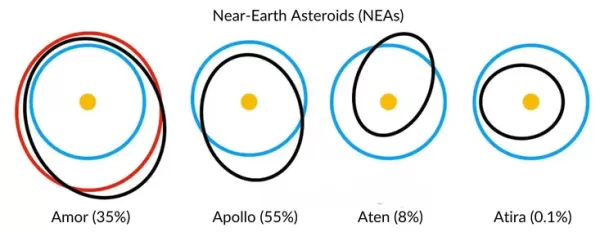
To mitigate these risks, astronomers categorize the NEAs into four primary orbital groups. Amor asteroids approach from outside without crossing our orbit, while Apollo and Aten asteroids possess orbits that physically intersect Earth’s path, representing much higher threat levels. The rare Atira class orbits entirely inside Earth’s trajectory. Planetary defense researchers continuously monitor these classifications to accurately predict potential impacts decades in advance. When hazardous objects are definitively identified, defensive methods like kinetic impactor missions can be deployed to effectively alter their trajectories. Crucially, global planetary defense heavily relies on citizen science projects, where public volunteers analyze vast datasets of astronomical images to discover hidden celestial hazards every day.