
Table of Contents
7.4 Search for Extraterrestrial Intelligence
1. Rise of complexity
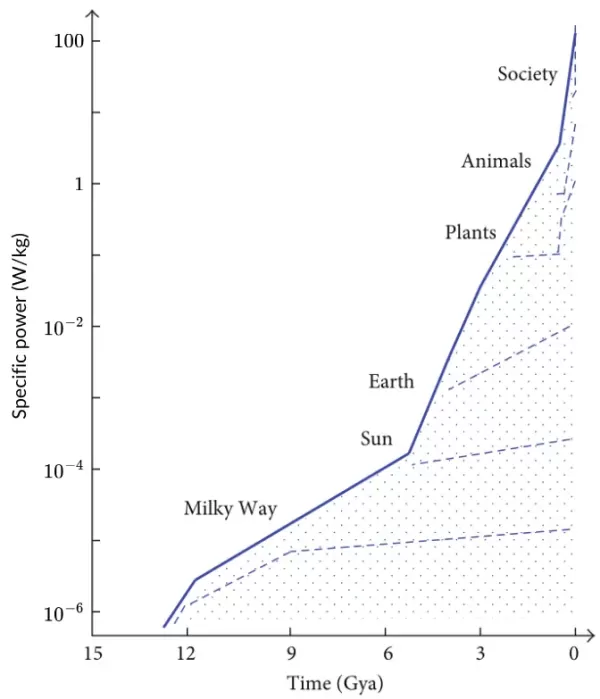
In the context of Eric Chaisson’s work, specific power (also known as energy rate density) is defined as the amount of energy flowing through a system per unit of time per unit of mass. Measured in units of W/kg (watts per kg), this metric serves as a quantitative measure of a system’s “metabolism.” Chaisson argues that while total energy or total complexity is difficult to compare across vastly different scales—such as a star versus a human brain—specific power provides a universal yardstick. It represents the energy required to maintain a system’s internal structure and order against the natural tendency toward entropy.
The figure illustrates the rise of complexity by plotting the historical trajectory of specific power across cosmic time. It shows a clear, non-linear progression where newer, more complex systems exhibit significantly higher energy rate densities than their predecessors. Starting with the Milky Way at approximately $10^{-5}$ W/kg, the line ascends through the Sun and Earth ($10^{-3}$ W/kg), marking the transition from galactic and stellar evolution to planetary development. As physical systems gave way to biological ones, the slope steepens dramatically. Each “jump” on the graph represents a threshold where a system has developed a more intricate structure capable of processing energy more densely to sustain its complexity.
The final segments of the graph highlight the transition from biological to cultural evolution. Plants and Animals ($1$ W/kg) represent a leap in energy density due to photosynthesis and active metabolism, respectively, but the sharpest spike occurs with the emergence of Society ($100$ W/kg). Modern human civilization, through the use of technology and fossil fuels, processes energy at rates orders of magnitude higher than any natural biological or astronomical system. This illustrates Chaisson’s “Cosmic Evolution” narrative: as systems become more complex and information-rich, they require exponentially more energy per unit mass. The figure thus suggests that complexity is not just an aesthetic trait, but a physical state driven by increasingly efficient energy utilization over 14 billion years.
2. The Great Silence in the Dark Forest
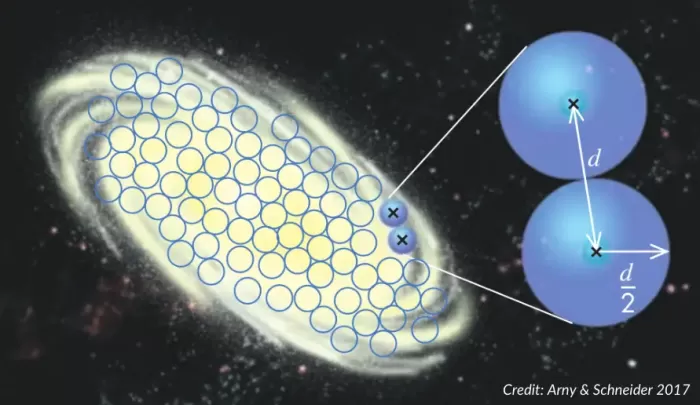
The statistical structure of the galaxy can be visualized by dividing the Milky Way into discrete “spheres of influence” to estimate the average distance between advanced civilizations. In this model, the galaxy is treated as a volume filled with potential habitats where each civilization occupies a sphere with a radius of $d/2$, and the distance $d$ represents the average separation between neighbors. This geometric approach directly addresses the Fermi Paradox—the glaring contradiction between the high probability of extraterrestrial life and the total lack of evidence for it. By treating the galaxy as a collection of isolated spheres, we can mathematically relate the number of active civilizations ($N$) to the vast physical dimensions of our galactic home, helping to quantify exactly how much of the “ocean” we have yet to sample.
This visualization highlights the daunting physical barriers to interstellar communication and the potential “Great Silence.” If the number of civilizations is low, the distance $d$ becomes immense, potentially spanning thousands of light-years, meaning signals might not reach a neighbor until long after a society has collapsed. However, the Dark Forest theory offers a more chilling explanation for these empty spheres: it suggests that civilizations remain intentionally silent because any “sphere” that broadcasts its presence is perceived as a threat. In this predatory environment, every civilization is a hunter, and the lack of detectable signals is not due to a lack of life, but a survival strategy designed to avoid the attention of more advanced, potentially hostile neighbors.
To pierce this silence, modern SETI efforts have shifted toward a broader search for “technosignatures”—unambiguous signs of technology like narrowband radio signals or Dyson spheres—rather than just waiting for a deliberate message. Current projects, such as the Breakthrough Listen initiative and the SETI Institute’s Allen Telescope Array, are leveraging Moore’s Law to exponentially increase our search capacity through better computing power. While past efforts were often described as searching only a “cup of water” from the cosmic ocean, recent advancements have expanded this search space to the equivalent of a “hot tub,” utilizing new strategies that look beyond traditional radio waves to explore a much wider variety of potential technological markers across the stars.
Ultimately, the “packing” of these spheres represents the concept of the Galactic Habitable Zone and the temporal constraints of our current search. The existence of detectable advanced civilizations is a function of their density and their willingness to be seen; for a neighbor to exist within 100 light-years, millions of active civilizations would need to be scattered throughout the Milky Way. Such a high density has yet to be supported by observational data, suggesting that either $N$ is very small, the “Dark Forest” maintains a state of universal caution, or we are simply in the early stages of a very long road toward discovery. As formal academic frameworks and new textbooks begin to standardize the field, the search continues to mature from a speculative endeavor into a rigorous, interdisciplinary science.