Table of Contents
This is an old revision of the document!
7.4 Search for Extraterrestrial Intelligence
1. Rise of complexity
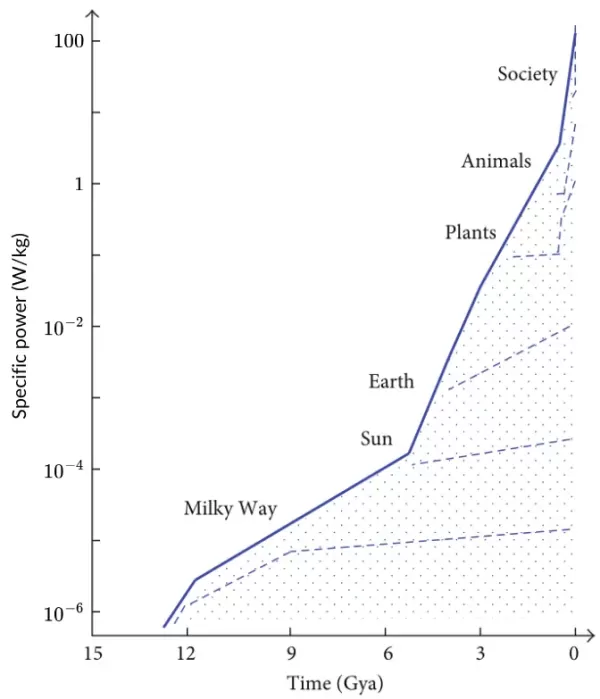
In the context of Eric Chaisson’s work, specific power (also known as energy rate density, denoted as $\Phi_m$) is defined as the amount of energy flowing through a system per unit of time per unit of mass. Measured in units of W/kg (watts per kg), this metric serves as a quantitative measure of a system’s “metabolism.” Chaisson argues that while total energy or total complexity is difficult to compare across vastly different scales—such as a star versus a human brain—specific power provides a universal yardstick. It represents the energy required to maintain a system’s internal structure and order against the natural tendency toward entropy.
The figure illustrates the rise of complexity by plotting the historical trajectory of specific power across cosmic time. It shows a clear, non-linear progression where newer, more complex systems exhibit significantly higher energy rate densities than their predecessors. Starting with the Milky Way at approximately $10^{-5}$ W/kg, the line ascends through the Sun and Earth ($10^{-3}$ W/kg), marking the transition from galactic and stellar evolution to planetary development. As physical systems gave way to biological ones, the slope steepens dramatically. Each “jump” on the graph represents a threshold where a system has developed a more intricate structure capable of processing energy more densely to sustain its complexity.
The final segments of the graph highlight the transition from biological to cultural evolution. Plants and Animals ($1$ W/kg) represent a leap in energy density due to photosynthesis and active metabolism, respectively, but the sharpest spike occurs with the emergence of Society ($100$ W/kg). Modern human civilization, through the use of technology and fossil fuels, processes energy at rates orders of magnitude higher than any natural biological or astronomical system. This illustrates Chaisson’s “Cosmic Evolution” narrative: as systems become more complex and information-rich, they require exponentially more energy per unit mass. The figure thus suggests that complexity is not just an aesthetic trait, but a physical state driven by increasingly efficient energy utilization over 14 billion years.
2. SETI