Research · Facilities
TART
Transient Array Radio Telescope — CASSA's radio instrument at IUB CORE (Campus Observatory for Research and Education), and Bangladesh's first radio telescope. A 24-antenna aperture-synthesis array built at IUB — the only synthesis-array radio telescope in the country.
Radio Telescope
About TART
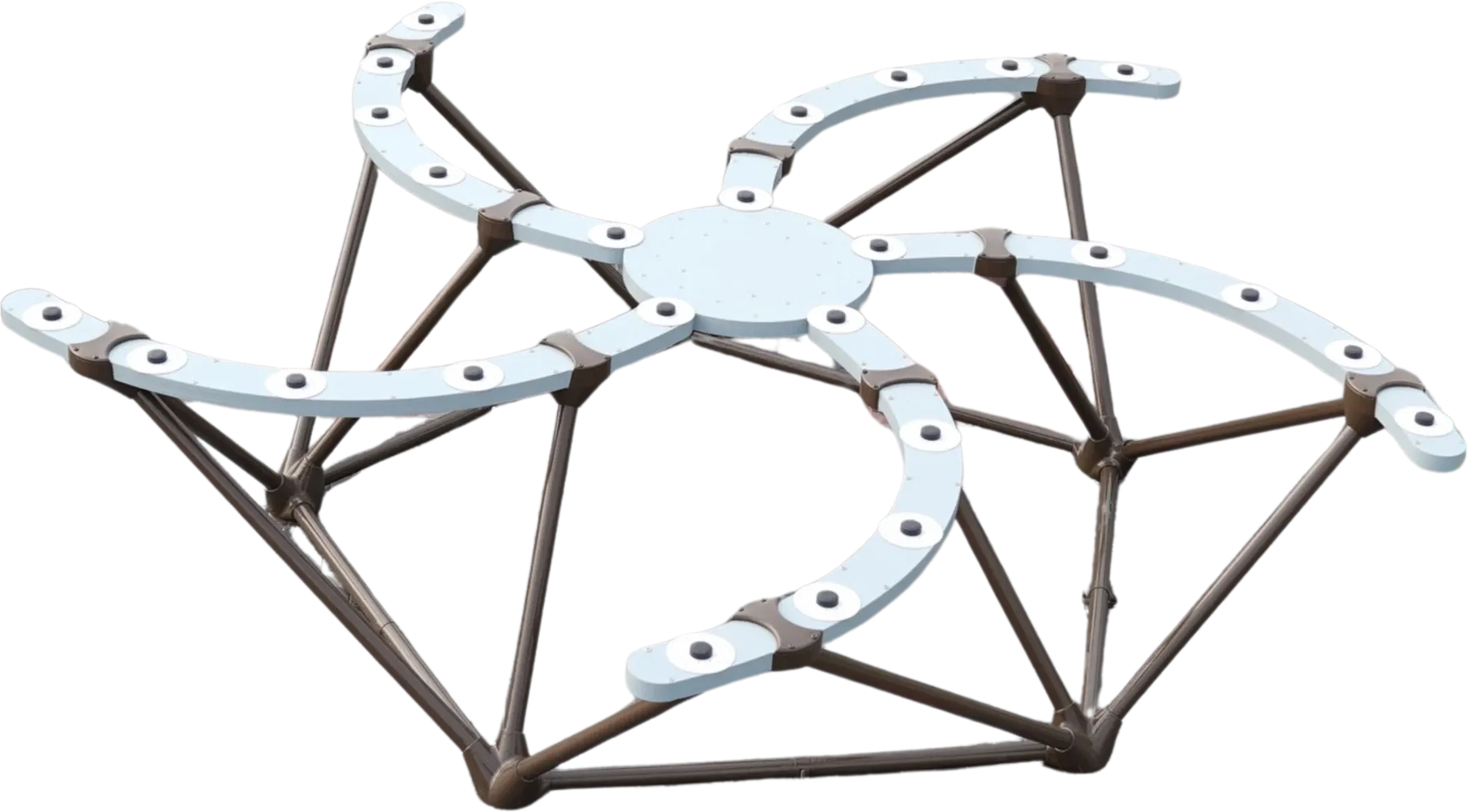
TART — the Transient Array Radio Telescope — is CASSA's radio instrument, housed at IUB CORE on the rooftop of the Main Academic Building. Every one of its 24 all-sky GPS antennas is correlated with every other to form 276 baselines, and an open-source aperture-synthesis pipeline turns those into a full-sky radio image about once a minute. It is operated by CASSA as part of the RAIN (Radio Astronomy Instrumentation) research area.
Full Name
Transient Array Radio Telescope (TART)
Location
IUB CORE, Main Academic Building rooftop, IUB Bashundhara
Array
24 GPS/GNSS antennas · L1 band, 1.575 GHz · 276 baselines · full-sky image every minute
First Light
18 November 2025, during CASSA Workshop 2
How it was built
An international partnership, assembled at IUB
The build · a partnership
An international partnership
TART at IUB is the product of an international collaboration. The receivers and digital electronics — the heart of the instrument — were designed and supplied by the open-source TART project at the University of Otago, New Zealand. The antenna array was fabricated at the IUB Fab Lab, and CASSA provided the rooftop site, student researchers, and project coordination, with funding from IUB.
After more than six months of work — held up for a time by electronic complications — the instrument was assembled and brought online during CASSA Workshop 2, "Installing a Radio Telescope to Image the Invisible" (17–21 November 2025). It detected its first radio signals on 18 November 2025, under the supervision of Dr. Tim Molteno, who brought the final electronic components that completed the build. Thirty students from eleven universities took part in the hands-on assembly.
Read the full story: IUB launches Bangladesh's first TART →
Receivers & electronics
Dr. Tim Molteno and his team at the University of Otago, New Zealand — the open-source TART project that designed and supplied the receivers and electronics.
Array structure
Designed and fabricated at the IUB Fabrication Laboratory (Fab Lab) by Shoaib Mirza, with students Yusa Islam and Md. Shahadat Hossain Shahal.
Space, location & student expertise
CASSA — the rooftop site at IUB CORE, project leadership, and the student researchers who built and now operate the telescope.
Funding
The Department of Physical Sciences, IUB, together with CASSA.
Live data
Live from TART
TART images the entire sky about once a minute and shares it live across a
worldwide network of low-cost array telescopes. Explore the global network below —
Bangladesh's bd-iub node joins telescopes across Africa and New Zealand.
Science
What TART observes
Science Capabilities
Radio science with TART
TART is the foundation of CASSA's in-house radio observation programme and a hands-on training ground for student researchers. As part of the RAIN research area, it is a testbed for the calibration workflows, primary-beam characterisation, and data-reduction pipelines that carry directly across to far larger arrays such as LOFAR and the Square Kilometre Array (SKA).
Transient Detection
Catching short-lived radio events — cosmic rays and other transients — that optical telescopes miss
Ionospheric Science
Measuring the total electron content (TEC) of Earth's ionosphere using GNSS signals
Calibration Research
Using the many GPS satellites overhead as bright references to characterise the array's beam and gains
Pipeline Development
Building synthesis-imaging and calibration pipelines that scale to LOFAR and the SKA
Open source
Build with TART
TART is fully open source — hardware, FPGA firmware, and imaging software, all
under GPLv3 and stewarded by the Electronics Research Foundation in New Zealand.
Every visibility and image is public, so the whole pipeline is reproducible end to
end. Install the Python tools with pip3 install tart-tools.
Tutorials & documentation
- Documentation home ↗ The full TART docs hub
- TART in 5 minutes ↗ A quick overview of how it works
- Getting data from TART ↗ Download visibilities from the API
- Making images ↗ Turn visibilities into all-sky images
- The TART API ↗ REST endpoints for every telescope
- tart-tools on PyPI ↗ pip3 install tart-tools
Code on GitHub
- tart-telescope (GitHub org) ↗ Hardware, firmware, web app & infrastructure
- tart_modules ↗ Core Python library + command-line tools
- TART ↗ PCB designs & FPGA firmware — the hardware root
- tart2ms ↗ Convert TART data to CASA Measurement Sets
- sbc_code ↗ On-telescope software + the REST API server
- web_app ↗ The live telescope dashboard front-end
- notebooks ↗ Example Jupyter notebooks using TART data